Care and Feeding is Slate’s parenting advice column. Have a question for Care and Feeding? Submit it here.
Dear Care and Feeding,
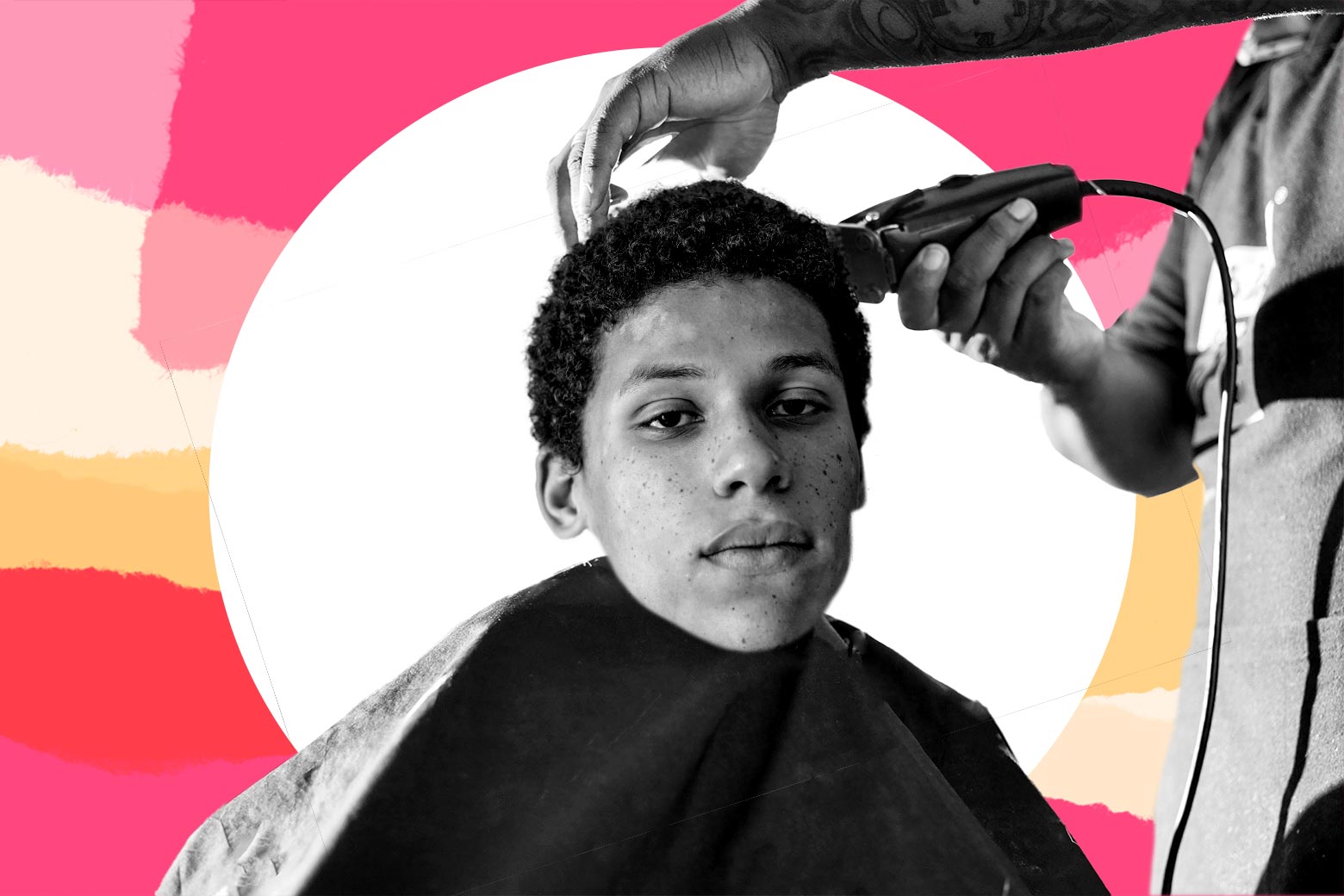
I’m a white woman, married to a mixed-race Dominican man. He’s usually a wonderful dad, but right now we’re in a fight about our son’s hair. When I was pregnant with our first child, a daughter, our friends and his female relatives generously taught me about hair care and styling. She takes after her paternal grandmother with tight, coily curls, and I think I’ve done an OK job because she’s always been confident and happy with her hair. My husband was always chill about it, and she could try whatever she wanted as long as it was in budget.
He’s not chill about our son’s hair. Our son is a little younger, at 16. His hair is very similar to his sister’s. And he wants to try the haircuts and styles that his friends and classmates have. My husband absolutely forbids it, which is very not like him. He thinks there are only a small handful of correct styles for our son.
When I asked him why, he said it’s cultural, and our son needs to look like a man, which is also so out of character. He doesn’t just forbid white hairstyles, which realistically might not work for our son. He also vetoes our son’s desire for most of the cuts and styles that other mixed-race and Black kids at school, who are not Dominican, have. Having a dumb haircut and experimenting is a teen rite of passage, and I want our son to have it if he wants! He’s just a kid, and this is a normal time for him to explore. On the other hand, my husband is right that the nuances of race and culture are lost on me here, and I don’t know what to do.
—He’s Just a Kid
Dear He’s Just a Kid,
Sixteen is a fair age to let your son choose his own haircuts. If there’s a style he wants to try, he generally should be able to try it—or you’ll risk him resenting you both. You didn’t mention any specific styles, but I’m wondering if this has to do with your husband thinking the styles your son wants are too feminine, since he seems to have no issue with your daughter experimenting.
A lot of the popular styles for teen guys today might lean on longer hair or a mix of braids and cuts, long curls, or maybe even dyeing their hair a little—styles that the Black and mixed men of my generation didn’t really try. Sometimes, in our society, people unfairly equate cultural tradition with what is appropriate for young men to do, wear, or act. I’m making an assumption here, of course, but it sounds like it might be the case with your husband.
You have the right to advocate for your son to make his own decisions about his appearance. He’s at an age where it’s important that he gets these kinds of freedoms and is allowed to try new things. I would lean into that argument when speaking to your husband. Because I think he might be confusing his own idea of what “a man” looks like with an antiquated way of thinking that’s not fair to your son.
Get parenting and family advice—submit a question!
Please keep questions short (<150 words), and don‘t submit the same question to multiple columns. We are unable to edit or remove questions after publication. Use pseudonyms to maintain anonymity. Your submission may be used in other Slate advice columns and may be edited for publication.
Dear Care and Feeding,
My wife, “Susan,” and I have a 3-year-old daughter, “Valerie,” and a 15-month-old son. The weather will be warming up soon, and I raised the subject of signing Valerie up for swimming lessons the other day. My wife flipped out and said there was “no chance, end of discussion.”
For background, Susan lost her younger sister to a drowning accident in a lake when she (my wife) was 8, while her family was visiting her grandparents. Susan is adamant that our kids never go anywhere near water. If we want our kids to remain safe around water, a big step would be to make sure they can swim. I don’t want to come off as insensitive, but this is not a realistic expectation, especially as the kids get older. What can I do to convince my wife that having the ability to swim is a major safeguard against the very tragedy she doesn’t want to see repeated?
—Be Wise Around Water
Dear Be Wise Around Water,
I think it’s important to be sensitive to your wife’s trauma. As someone who has lost a lot of family members in unexpected ways, I’ve seen how certain conversations can trigger my family members. But, with this in mind, the facts are really your best friend here: Kids who learn how to swim with formal swimming lessons significantly decrease their risk of drowning. Also, explain that swimming lessons are not only about swimming. They also teach kids water safety and other lifesaving skills, such as how to flip over on their back and float, and how to safely help a friend in the water. Many of us adults could actually use a refresher on these lessons!
The other part of this is to find a company or swimming coach that your wife will feel comfortable with. Ask around for referrals, show her videos, and visit classes before agreeing to them. Opt for classes that incorporate parents so you would be able to be in the water with them at all times, possibly easing your wife’s stress a bit.
During this process of finding a class and getting her to agree to it, take your time with her because she’s going to need it. Even if you’re right that these swim lessons are the safer option rather than avoiding water for the rest of their lives, your wife needs your patience so that she can start to build trust in whoever you both decide to try.
We Want to Hear Your Petty Work Drama!
Laura Helmuth and Doree Shafrir want to help you navigate your social dynamics at work. Does your colleague constantly bug you after hours? Has an ill-advised work romance gone awry? Ask us your question here!
Dear Care and Feeding,
My wife and I have a 3-year-old son, “Manny,” and a 4-month-old daughter, “Raya.” About a month after Raya was born, Manny began wanting to sleep in bed with us. Given the major changes he was experiencing with the addition of a new sister, we allowed it, thinking it would be temporary. It’s been three months; when we tried making him go back to his own room, he began wetting the bed. He’s now back with us, and the bed wetting has stopped, but what are we supposed to do in terms of getting him back in his own bed, where he belongs?
—Third Wheel
Dear Third Wheel,
My question is: Do you want Manny to go back to his bed because you truly want your space back, or do you think that it’s just inappropriate for him to be sleeping with you every night? I ask because many parents cosleep until their kids are ready to go back to their rooms, so, if it’s not a problem for you, no rule says he can’t stay.
But if what you’re really wanting is that privacy and space back, it’s a bit more challenging. Much of the advice on this subject involves being really strict with your little one and telling them not to leave their room for any reason. I already don’t love that approach, and since Manny is only wetting the bed in his room, there’s some kind of discomfort he has in there, so I wouldn’t add any additional stress by forcing him to stay put all night.
I suggest letting him know that you’re close, maybe allowing him to come into your room once a night if he needs anything (an extra hug, another story, something to drink), and adding a baby monitor so that he can talk to you. Focus on helping him feel connected to you even when he’s in his room. Strengthen the connection between your room and his instead of enforcing the separation.
—Arionne
More Advice From Slate
Four years ago my sister had a baby, and when he was learning how to talk, his grandparents, my parents, became “GoGo” and “Papa.” My husband and I now have a 16-month-old daughter. I’m known as Mama, her dad is Dada, and she’s just starting to call my parents GoGo and Papa at everyone’s encouragement but my husband’s. He cringes every time anyone refers to my dad as Papa but has never said anything to my parents—instead, he privately fumes to me that he thinks “Papa” should be his name.