
Sign up for the Slatest to get the most insightful analysis, criticism, and advice out there, delivered to your inbox daily.
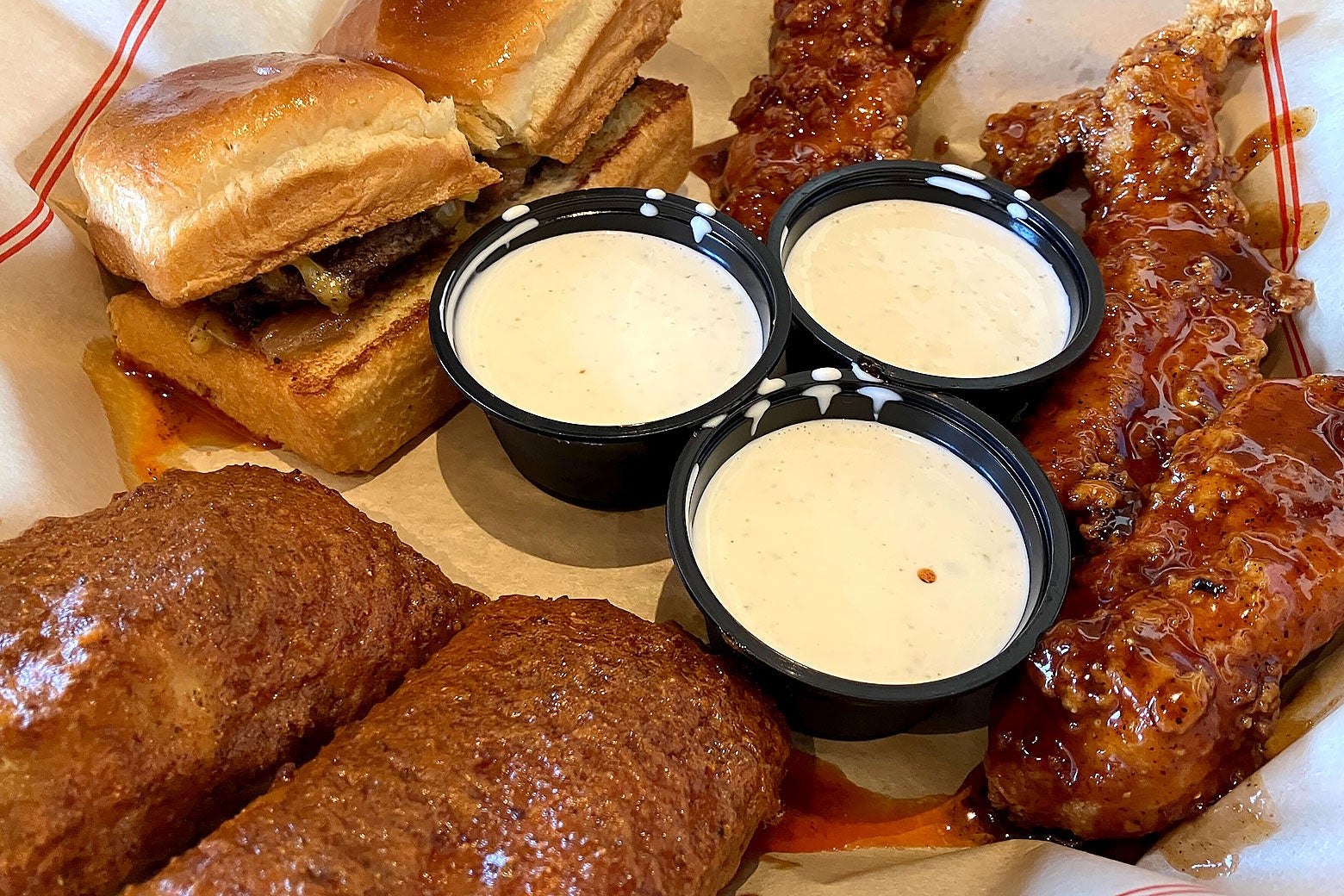
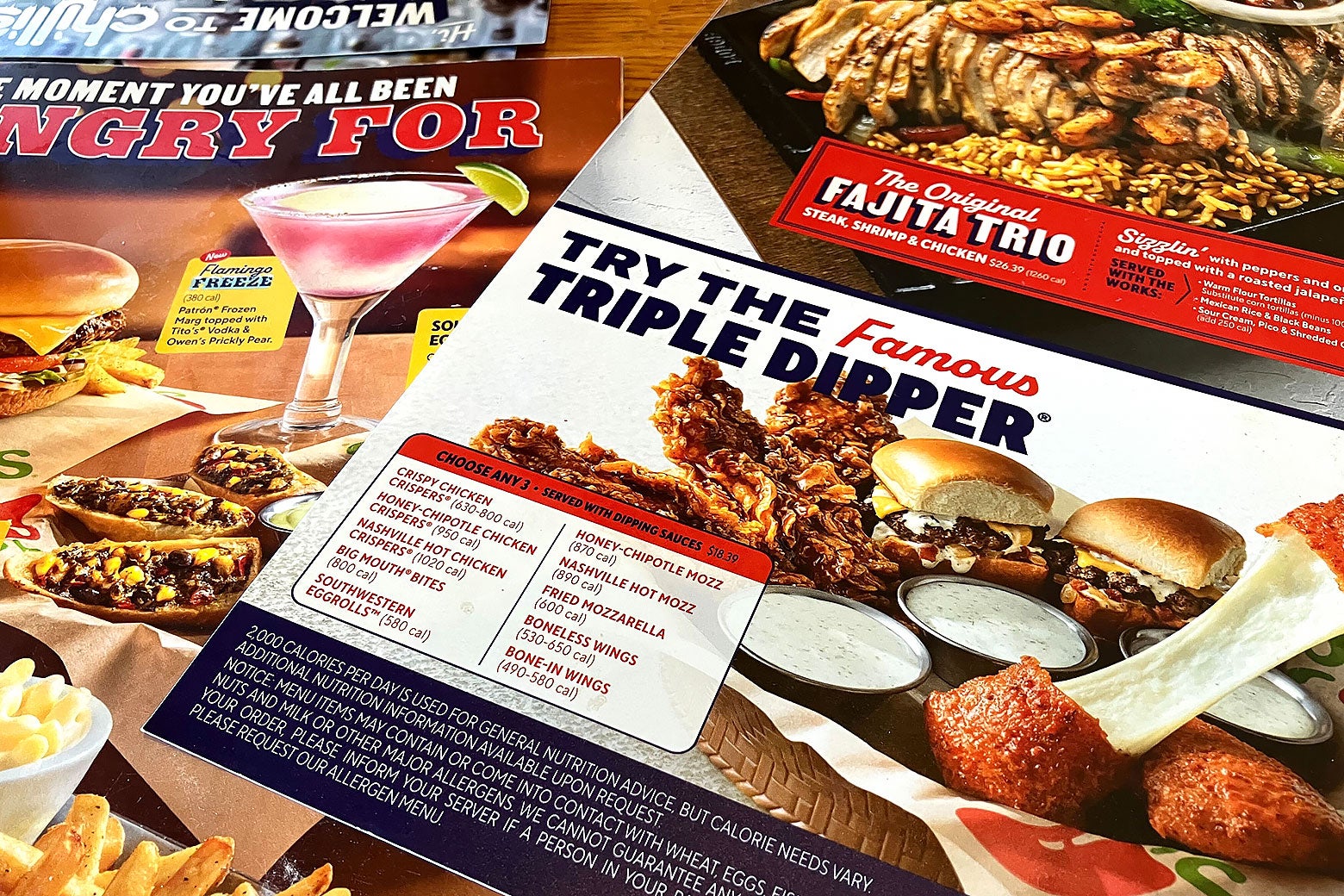
It was lunchtime, and this Chili’s in suburban Dallas was hopping: office friends gossiping, parents eating chips and salsa, their kids gaming on Chili’s-branded Ziosk tablets. Nearby, a landscaping crew in matching uniforms devoured fajitas. Tom Petty played on the stereo. Our server had just placed a smorgasbord before us, including a Triple Dipper appetizer combo in the now-canonical configuration: Big Mouth Bites, Honey-Chipotle Chicken Crispers, and Nashville Hot Mozz.
Across from me, George Felix luxuriated in the vibes. Three years ago, when he was hired as the chief marketing officer at Chili’s, his friends from business school all had the same reaction, he told me. “They’d all smile and be like, ‘Oh, man, I love Chili’s!’ ” Felix said. But then they’d say, “I haven’t been there in 10 or 15 years.”
Felix grabbed a french fry and held it up as if to illustrate his point. “So, as a marketer, I looked at the challenge as: How do we make Chili’s relevant again?” he asked. “How do we remind people why they loved this brand in the first place?”
In my college years, I was a regular at the Chili’s on 15-501, just a few miles from campus. I had very specific opinions about the merits of Chili’s versus its direct competitors along that highway: Applebee’s, Tripps, TGI Fridays. I could distinguish an Awesome Blossom from a Bloomin’ Onion by mouthfeel alone.
But until recently, like Felix’s friends, I hadn’t set foot in a Chili’s in decades. The world is full of better restaurants, I’d reasoned as I got older. Restaurants that are not big chains running their food through conveyor-belt ovens, deep-frying everything, mandating how their employees talk to me. These days, when I think of casual restaurants in this class, I laugh about Office Space’s Chotchkie’s, with its mandatory flair; when I think of Chili’s specifically, I think of The Office and its characters’ devotion to the Scranton outlet. Sure, I like that show, same as anyone, but this kind of product placement seems like an anti-endorsement. No one watches The Office and thinks, I want to be like those hopelessly uncool corporate drones. Do they?
And yet Chili’s is undergoing a renaissance. Three years ago, Felix was one of a team of executives brought in to steer Chili’s in the post-COVID era. Led by CEO Kevin Hochman—who formerly oversaw similar revivals at Old Spice and KFC—Chili’s has transformed from a ’90s relic to the hottest restaurant chain in the country. Same-store sales were up 31 percent in the first quarter of 2025, the fourth straight quarter of double-digit growth. It’s a corporate turnaround for the ages, what one giddy restaurant analyst described as “the best one of all time in the space.”
“I can’t tell you how much of a surprise Chili’s performance has been within the industry,” said Jonathan Maze, editor in chief of Restaurant Business, the trade magazine that has avidly covered the chain’s jaw-dropping resurgence, including in a recent cover story. “It is just shocking.” And while Chili’s has been awesomely blossoming, its closest competitors have been fighting for their lives, Maze pointed out: “TGI Fridays: filed for bankruptcy, dramatically shrinking. Ruby Tuesday is a shell of its former self. Applebee’s hasn’t had a positive quarter in two years. So the idea that Chili’s would do 30 percent—that’s ridiculous.”
But it’s not just that Chili’s is making money hand over fist. The mozzarella sticks are going viral on TikTok. A Chili’s-produced minimovie celebrating National Margarita Day, starring Maria Menounos and Taye Diggs, just aired on Lifetime. And just when we thought hanging out was dead, Gen Z–ers seem to have rediscovered the joy of going out with friends, pounding a marg, and eating a gut-busting quantity of food. This 50-year-old chain restaurant, this totem of Scranton squareness, has somehow become … cool?
I visited Chili’s HQ outside Dallas to find out how it all happened. I operated a fryer for the first time since my teens, tried not to roll my eyes when people used the word Chilihead, and nerded out over the systems optimization that might be the brand’s secret weapon. I went to Texas dubious, but 9,000 calories later, I’m afraid I’ve become a true believer. Chili’s may not be the best restaurant in America—but it is the exact restaurant America needs right now.
It started with the cheese pull. “If you come just for the mozzarella sticks, like, I wouldn’t judge you,” one TikTokker intones in an April 2024 video that’s been viewed 6.5 million times. She takes a bite of a breaded cheese stick and stretches the mozzarella, like, a foot and a half away from her mouth. “Because—look at that.”
I could not identify the patient zero of the cheese-pull phenomenon, but it was around this time that Chili’s became inescapable on TikTok—everyone stretching cheese as far as they could while praising the Triple Dipper. In some respects, this was very funny: Gen Z had discovered mozzarella sticks. But inside Chili’s, it created an unexpected problem: How do you maintain momentum from a viral moment you had barely anything to do with?
The Triple Dipper, after all, was a simple three-appetizer deal that preceded the new management group’s reign. Felix’s marketing team had been occupied with the launch of a new burger, the Big Smasher, when suddenly—in a matter of days—the social-media numbers went through the roof, and Triple Dipper sales doubled.
James Butler, who oversees the company’s supply chain, went on a mozzarella-buying spree—“I had a little bit of a freak-out moment, because I thought, Maybe we bought too much cheese”—and visited restaurants to get a sense of how the kitchen was dealing with the rush. In one, he saw a worker at the fry station brush chicken tenders with the company’s Nashville Hot sauce, and suddenly wondered, Would that be good on a mozzarella stick? The next day, he said, he took the idea to the test kitchen on the ground floor of HQ, and within 10 minutes, the culinary team had produced a prototype.
Meanwhile, Felix was looking at the social numbers and wondering, What’s the next thing we can do to bring actual news to this? When Butler called him down to the test kitchen and presented his new invention, Felix knew this was it. “Oh, man, that’s really, really good,” Felix recalled saying. “We should probably do something with this.” No one wanted to wait for the next quarterly menu print to add the item, so within a few months, instructions had gone out to restaurants, and the social team had influencers touting a new secret order at Chili’s: Nashville Hot Mozz.
In one way, it’s funny to hear C-suite executives describing this fried appetizer iteration in the kinds of awestruck tones usually reserved for, like, the discovery of penicillin. (“Innovation doesn’t happen in a vacuum,” said the company’s head of culinary in his acceptance speech at the 2025 MenuMasters awards, where the Hot Mozz won Best New Menu Item.) But by the poky standards of corporate restaurant culture, the response to the cheese-pull moment really did represent a miracle of nimble pivoting. And it worked: “You see a lot of restaurant brands that have success on TikTok, with a viral moment, and you’ll see kind of a boom-splat,” Felix said. “Three, four weeks of huge excitement, massive spikes in sales, and then things return back to where they were.” Chili’s, notably, has not returned back to where it was.
The executives I spoke to pointed further back than the chain’s viral moment, though, to explain why new customers have stuck around. Three years ago, when the new executive team took charge, it set out to streamline operations, transforming Chili’s into a company able to make changes quickly—and to handle sudden success smoothly. Since those execs came on board, the chain has eliminated 25 percent of the items on its menu. You can no longer, for example, purchase chili at Chili’s.
Each time a menu item gets the axe, customers—and servers, who have to deal with customer complaints—bemoan its loss on the Chili’s subreddit, but the kitchen staff breathes a sigh of relief. (Contrast a server’s complaint about the disappearance of corn on the cob with a cook’s hallelujah.) The company has eliminated unpopular wing sauces, 86’d a superfluous fried-chicken batter, and thinned out the burger menu—all in service of making the kitchen a more simple place to work. It has replaced conveyor-belt ovens that leaked heat into an already-hot kitchen with smaller, quicker TurboChefs—a change that’s easy to make when, unlike other chains, your restaurants are 99 percent company-owned rather than franchises.
I was struck, in my conversations with Chili’s new executive team, by how uninterested they seemed in articulating any big inspirational message they’d delivered to the company. Instead, everyone just wanted to talk about the shrimp. The kitchen staff used to painstakingly count out the exact right quantity of shrimp for the chain’s fajita platters. When a cook complained to Hochman, the CEO, about it, he wondered if cooks could just eyeball it instead. It turns out that works just fine, and now Chili’s cooks are allowed to scoop a big old handful of shrimp onto the grill.
When you visit Chili’s HQ, the 216,300-square-foot building in Irving, Texas, where these decisions get made, the guy who gives you the tour is the same guy who says, “Hi, welcome to Chili’s!” when you call any Chili’s on the telephone. His actual name is Kris Bunn, and his actual job is with the events production team, but he’s also the walking, talking embodiment of Chili’s enthusiasm—what people at the company call, with zero shame, a “Chilihead.”
What is a Chilihead? I heard lots of definitions, mostly revolving around ideas of hospitality, selflessness, and unflappability. One executive mused that it had to do with “servant leadership,” placing the Chilihead in the same stratum as Jesus, I suppose. But I would define a Chilihead most simply as someone who really freaking enjoys working at Chili’s. While the r/chilis subreddit—like every casual restaurant chain’s subreddit—features no shortage of employees complaining about their shifts, their managers, and their stupid customers, to my surprise it also features a number of regular posters who refer to themselves as Chiliheads.
Bunn walked me along a wall displaying the 50-year history of the company, starting with its beginnings as a single Mexican-ish restaurant on Greenville Avenue in Dallas. Even then, the apostrophe in the logo was a pepper. Texas red chili cost $1.50; beer was 75 cents. We walked past a basketball Pop-a-Shot and a Chili’s-branded BurgerTime arcade game in an employee hangout zone overlooking the neighborhood’s artificial lake. We walked past a board listing the staff-supplied names of Chili’s conference rooms: Be Our Guest, the Rib Crib, Check Please. We walked past the company’s quality-assurance lab for its various restaurant display technologies. “If you’re a spy from Applebee’s or something, you will not be getting access to this room,” Bunn said. I believed him.
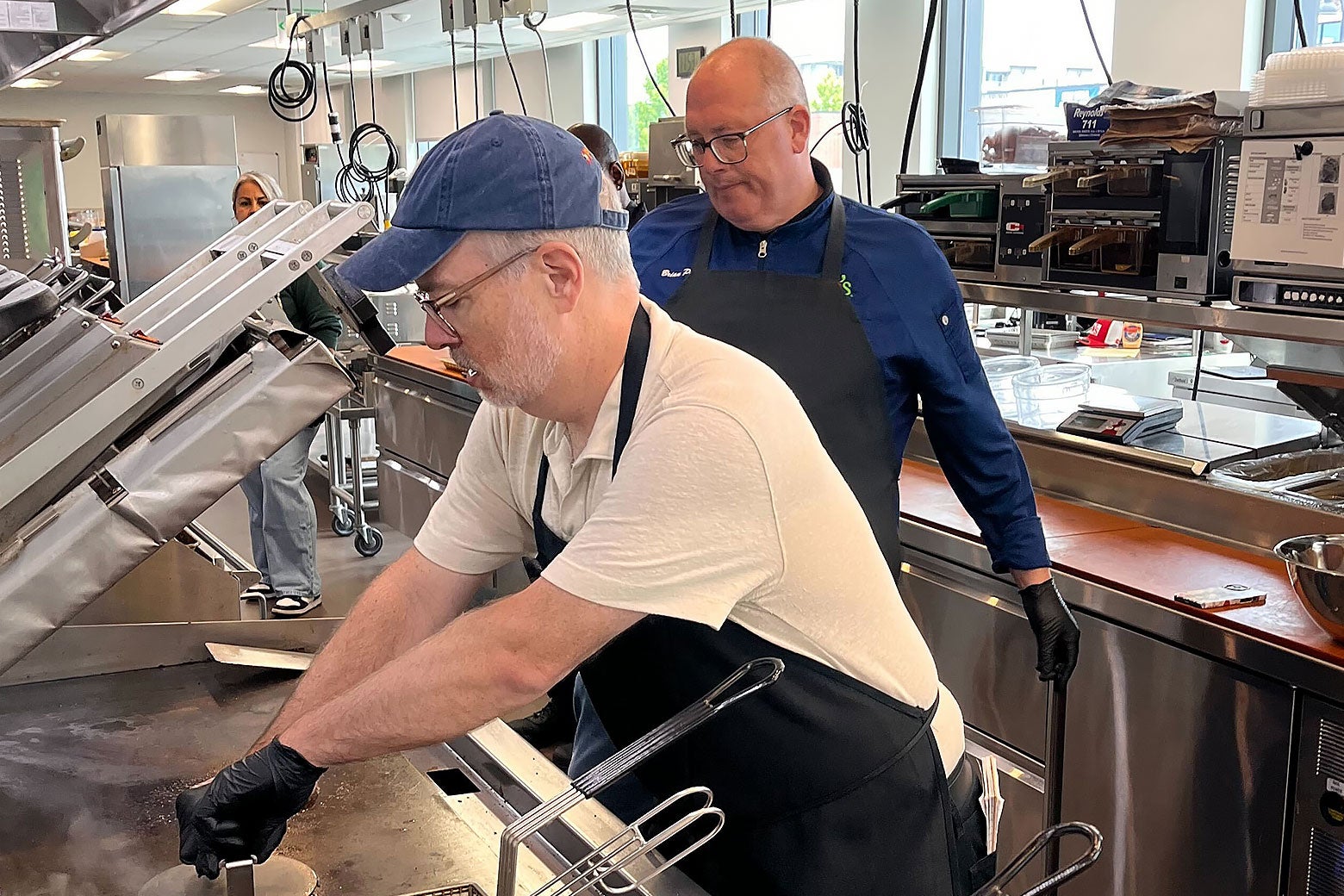
The centerpiece of the tour was a visit to the Chili’s test kitchen, where I met Chili’s head of culinary, Brian Paquette. “I’m in my 18th year at Chili’s,” Paquette, a burly, genial guy, told me. He started in a restaurant in Raleigh, North Carolina, as a trainee and later worked at the very Chili’s I frequented in college. “All of us here in the test kitchen were operators and cooks in restaurants,” Paquette said. “That’s unique for a restaurant brand of our caliber. Most brands are bringing in professionals—you know, chefs.” I laughed at the mild disdain with which he said the word. “We are a ragtag band of operators.”
His North Star, he explained, was simplification. “We take a real-life point of view as we’re developing, so that things can be executed easily in the restaurants. How do we make it easy for the operator, easy for the cooks, so they can stay busy, be busy, hopefully get busier?”
To demonstrate, Paquette handed me an apron and put me to work. We made burgers and fries, and I found I could still run a bun through a toaster and shake the oil out of a fryer basket. After I slapped my beef patty onto the grill, Paquette handed me a steel burger smasher. “We teach our teams to do a north-south-east-west rock,” he said, demonstrating a steady, four-quadrant action, “to get the right amount of pressure in all the right places.” I followed his instructions, while also instantly understanding that if I worked at a Chili’s and had 25 burger orders in the queue, I would never, ever, do a slow north-south-east-west rock. It wasn’t only the muscle memory of my high school job that had come flooding back—my instinct to work as little as possible when unsupervised had also kicked in.
But as I dumped fries into a plastic basket, Paquette pointed out an example of optimization even a layabout like me could appreciate. “We weren’t getting consistent seasoning on our fries, so we developed a little quality fix,” he said. He held up a shaker filled with salt and spices and pointed out the little holes on the shaker’s cover. “We call this the rose. The holes used to be pretty small, so we were having, like, 30 shakes on an order of french fries to get the right amount on there. That was a lot of shaking for the cooks. So we moved to this shaker.”
“It’s got bigger holes,” I observed.
“Bigger holes.” Paquette smiled proudly, as if I’d aced a test. “We only have to do five shakes. I know it’s a little silly,” he acknowledged, “but it has huge implications for the team, because it’s a lot faster, a lot easier, and it makes the flavor a lot more consistent.”
The Chili’s publicists had arranged for an enormous collection of dishes to be laid out on a table in the test kitchen: the burgers we made, a basket of chips and salsa, a Triple Dipper with Nashville Hot Mozz, the baby back ribs whose recipe Paquette had just spent months revamping. It made my stomach hurt a little to look at it.
“I’m on Zepbound,” I told Paquette. “I recognize that this is meant to be appealing, but I just think about how horrible I would feel if I ate all of this at once.”
Paquette nodded. “Coincidentally, I’m also on that medication,” he replied. We high-fived and shared our numbers. Then he said, “There’s been no internal guidance to address that, as far as innovation is concerned. No one’s saying, ‘We need smaller portions!’ ”
“I guess that’s not what people go to Chili’s for,” I said. I took a bite of the burger I’d cooked. It was pretty good.
“We don’t expect you to eat it all at once,” Paquette said. “These days, I get the fajitas? I can stretch that thing out for a couple nights.”
Hochman, the CEO, wasn’t in Dallas when I visited, but I talked to him a few weeks later. In our video call, he pointed his camera directly at the top half of his head and enthusiastically recounted the listening sessions he likes to run in Chili’s branches across the country. “You know, there’ll be folks there who are 20-year Chiliheads, 30-year Chiliheads,” he told me. “And they’ll say, ‘I’ve never met the CEO before.’ And I’ll say, ‘That’s so cool, ’cause I’ve never met you!’ ”
During our call, all Hochman’s gee-whiz energy was directed toward the small-bore changes that he feels, collectively, make the restaurant a better place to work. He likes to ask employees, “If you were CEO, what’s the one thing you would change tomorrow?” A server recently complained that whenever anyone ordered a plain cheeseburger, she had to tap the screen of her handheld tablet a million times: 86 LETTUCE 86 TOMATO 86 ONION …
“Why can’t it have an Only button?” Hochman asked. “You hit ONLY, and then CHEESE. We’re gonna eliminate hundreds of millions of taps a year. It’s making people super pumped to work here!”
In streamlining operations, in eliminating unpopular menu items, in focusing on the things Chili’s is most known for—burgers, fajitas, appetizers, margaritas, ribs—Hochman is evolving Chili’s from a restaurant that tries to have a little something for everybody to a restaurant that delivers big, popular things to the big, fat American middle. The company just revamped its jingle-famous ribs, switching from having a proprietary sauce to simply using Sweet Baby Ray’s. “It’s the most popular sauce in most American markets, so why wouldn’t we want to use it?” Paquette told me.
It’s all an acknowledgment that Chili’s is not going to compete with nonchain restaurants, or new fast-casual concepts, for trendy foods or challenging flavors. It certainly won’t compete on healthiness: The Guiltless Grill occupies just the teensiest corner of the menu—all those low-calorie options get about as much space as a single photo of a chicken tender, gooily dripping ranch dressing. But key to the revolution at Chili’s has been embracing what Chili’s actually is.
“Chili’s is about abundance,” George Felix told me as we surveyed the limitless piles of food delivered at that lunch, quantities of fried things that made me feel a bit ill. But I gotta admit that he was right: GLP-1 drugs be damned, no one ever went broke underestimating the appetite of the American people.
While the restaurant might innovate with something like Nashville Hot Mozz, that invention arrived several years after “Nashville hot” became a nationally popular flavor profile. “Chili’s is probably not going to be the brand that’s on the very, very forefront of a trend,” Felix said. “But we don’t want to be. We want to be on a trend just as it’s tipping into the mainstream. That’s the sweet spot for us.”
After all, he said, pointing to me, to himself, to the two friendly publicists who had joined us at lunch: “We’re not innovating for us. If we’re innovating for us, this would be a lot fancier.” He pointed around the restaurant. “We’re innovating for this population that’s right down the middle. We’ve got to have food that satisfies that guest, and that we can offer for a great value.”
Ah, yes, value. Chili’s is also about value. Felix’s marketing team noticed a rise in TikTok complaints about fast food prices—“I just went through the drive-thru, how did I spend $42?” “Fast food became the foil for us,” he said on a recent industry podcast, and the brand’s marketing emphasized how affordable the 3 for Me’s $10.99 base price was. It really worked, said Maze, the industry watcher. “People started saying, ‘Hey, wait a minute. If I’m spending this much at McDonald’s, why don’t I spend a little bit more and go to Chili’s instead?’ ”
Competitors are hurrying to catch up. Applebee’s introduced a $9.99 meal deal in November, and others, like Red Robin, are stressing low prices in their marketing. When I asked if he was worried about a race to the bottom on pricing, Felix said no. The price that gets customers in the door isn’t always what they choose to pay, he noted: More than half the customers who order a 3 for Me upgrade to a higher price point, up to $16.99. And he took pains to distinguish value from cheapness. “Right now, a lot of restaurants are mistaking good value for the lowest price point,” he said. “But I think, like, it’s pretty easy to see that when you have crappy food for a low price point, that’s not good value.”
Maze thinks that competitors are starting to learn other lessons from Chili’s too. “The better companies are starting to understand that you have to make sure the service inside your restaurant is really good. So they’ve put some investment behind” operations, technology, and service.
“Especially since the pandemic, the entire industry had been focused on takeout and drive-thru,” Maze said. “And here’s Chili’s getting 30 percent comps by convincing customers to spend a little bit of time. That’s actually pretty incredible.” While he’s not ready to say that casual dining is fully coming back, he does see halting signs of a rebound. “Olive Garden just reported a 6.9 percent same-store sales increase. BJ’s restaurants are growing sales. Red Robin, for God’s sakes, is showing improvement.” In the first quarter of 2025, casual dining restaurants outperformed fast food overall. “I can’t remember the last time that happened.”
I suppose I can believe that Felix had succeeded in the task he’d set himself: to remind people my age what they once loved about Chili’s, to appeal to our ever-potent nostalgia and our love of a bargain to get us back into the restaurant. But I still found the idea that young people were flocking to Chili’s hard to wrap my head around. Isn’t this the generation that hates to leave the house? That prizes convenience above all else?
I had to see it in person. So that’s how I would end my Chili’s journey—by taking a group of 18-year-olds there for dinner. They didn’t know what they were getting themselves into.
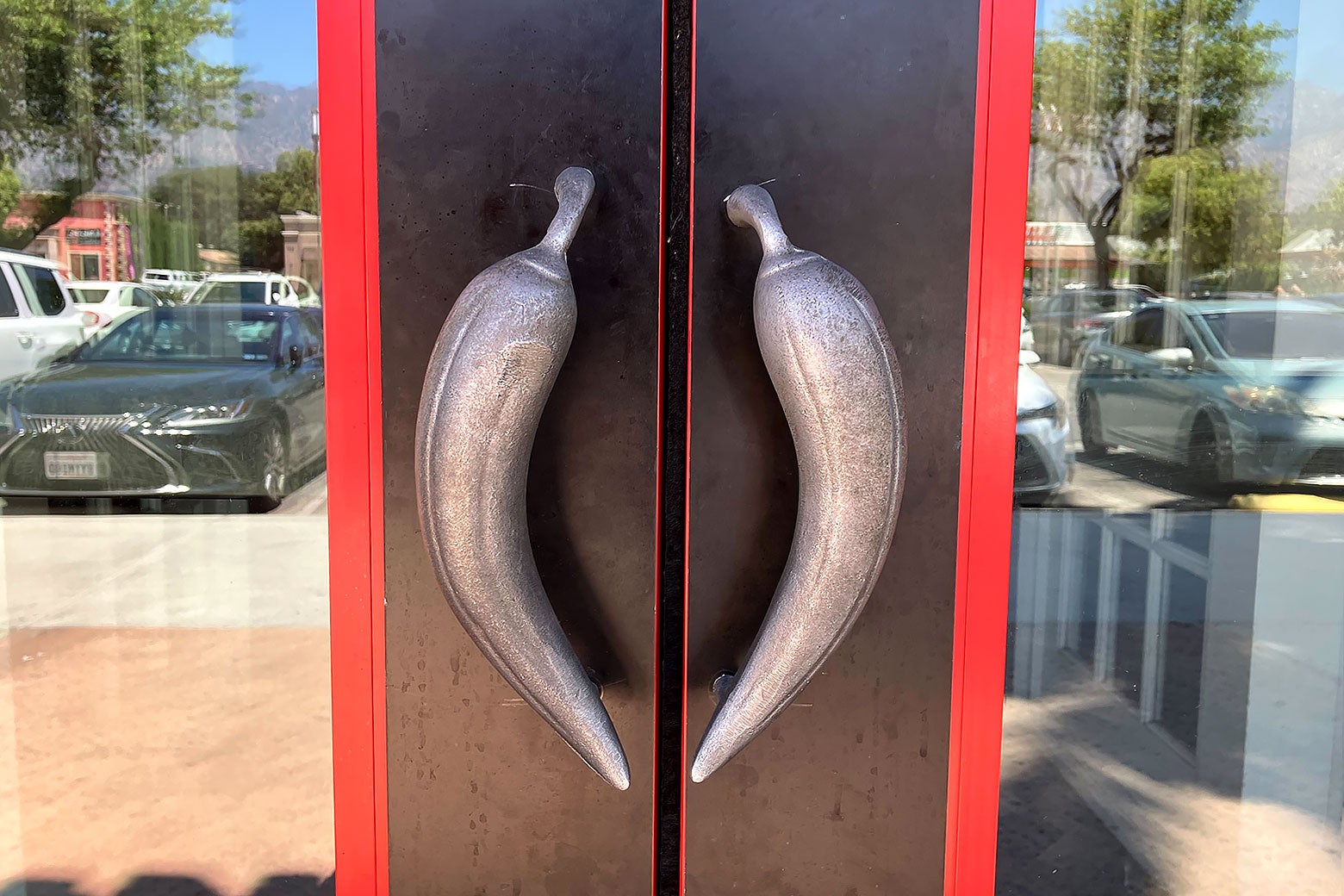
“Oh, the door handles are chiles,” said Harper, my daughter. “That’s cute.”
The host at this suburban Virginia restaurant failed to say, “Hi, welcome to Chili’s!” as we walked through the doors. In fact, in all my visits to Chili’s while reporting this story, the only Chili’s where the host fulfilled what every executive stressed to me was a crucial aspect of the brand experience was the one I walked into with the head of marketing, right down the road from company headquarters. But that was fine. I knew where we were. I could tell from the smell of fajitas, the Lovin’ Spoonful on the stereo, the four TVs tuned to four different ESPNs.
“Oh, is this a sit-down place?” asked Callie.
“Yeah, it’s like Cheesecake Factory,” said Mary Frances.
None of Harper’s friends had ever been to a Chili’s before. “Our part of Arlington, it’s more family-owned restaurants, more farm to table,” Mary Frances said. Indeed, we’d had to drive half an hour to get to the nearest Chili’s, outside the Beltway. We sat down in a booth, and the kids tried to make sense of the menu. I suggested a Triple Dipper. Chili’s executives had told me they thought that Gen Z’s love of variety—their desire to sample everything—was a key to the chain’s success with young people, and my group agreed. “It allows you to be indecisive while ordering things,” Callie said.
“Do you say it ‘motz’ or ‘mahz’?” asked Patrick.
“It’s ‘motz,’ ” said Harper, who of the four had been served the most Chili’s-themed Reels. “I just want a cheese-pull video.” While we waited for our food, Callie pounded a gigantic Shirley Temple and was brought another so quickly everyone started laughing.
The apps arrived. “Oh God,” Mary Frances said, dipping a Chicken Crisper. “Look at all these sauces.”
Harper held up a mozzarella plank. “Everyone take a corner,” she said. I filmed a video as they pulled the cheese apart, a quartering as messy as one in a medieval village square. “I kinda love this,” Mary Frances said.
I have certainly observed, in my own children, the younger generation’s infatuation with products that became obsolete just as they were born: the rotary dial phone, the disposable camera, the network sitcom. (Those whose knowledge of Chili’s doesn’t come from TikTok almost certainly encountered it on The Office.) Could the ’90s chain restaurant join this roster? The company is focusing on its golden era in marketing; Chili’s recently hired Boyz II Men to record the baby-back ribs jingle, after discovering that customers thought the group had sung it the first time. (In fact, originally, it was restaurant employees, and then a foursome of session musicians.) Even the look of the chain is moving in that direction; Felix told me the company is embarking on a multiyear redesign to distinguish its restaurants from other, identical-looking mall chains by throwing back—reinstating, for example, its once iconic tile tabletops.
“These kids have grown up with Chipotle,” said Maze, the restaurant-industry journalist. “And eating inside a Chipotle is basically eating inside a bus stop.” Compare that, he said, with Chili’s, where “it’s not like you’re going to Le Bernardin or something, but you’re still going in to sit down, have a meal, get served, and enjoy yourself.”
“Americans need restaurants,” Hochman told me. “With all the pressures people have today, to go out and be waited on, to be served—everyone needs something like that. You’re gonna see this resurgence across restaurants, I think, and we’re super pumped to be able to be part of it.”
Watching these teens, the summer before they leave for college, attempt to wash honey-chipotle sauce off their fingers with instantly refilled mugs of ice water, I felt my heart warm. Gen Z is hungry, I suspect, for anything better than their current situation, even if what’s better is absolutely, totally mid. Sure, the people in The Office are uncool corporate drones, but they have actual jobs and benefits. They assemble for fun-looking get-togethers at their local bar and grill. Sign us up!
And Chili’s is, without a doubt, the perfect brand for that extremely basic aspiration. America’s most middlebrow casual restaurant, with America’s squarest CEO, selling fried cheese and margaritas and fajita plates that you can eat off for days. TVs showing college football, a playlist that mixes classic rock and the already-forgotten hits of three years ago, employees who will be unfailingly friendly to you even if they’re too harried to say “Hi, welcome to Chili’s!,” décor that feels timeless in its taupe-and-hardwood anonymity, a set of systems relentlessly optimized so that even the most uninspired cook slammed by the dinner rush can turn out something that’s still pretty good. “You could see more people realizing, Hey, this kind of stuff is fun,” Maze said. “It’s probably better overall for society if people actually spend a little bit of time eating at a restaurant and hanging out with friends, rather than just sitting on their phones, eating in their damn cars.”
“I’m gonna lock in on this pizzookie,” Harper said with determination. “Have you seen those videos where the lady is like, ‘I’m gonna get my spark back,’ and then she eats a pizzookie?”
“What is a pizzookie?”
“It’s a chocolate chip cookie the size of a personal pizza.”
The cookie arrived, hot in a skillet with a scoop of rapidly melting ice cream. “It’s really underbaked,” said Harper.
“I kinda love it.”
“It’s giving coffee cake?”
Mary Frances was a little dubious about the whole project. “I feel like if I’m gonna go out, I’m gonna go someplace nice that’s really good,” said Mary Frances. “If I’m gonna go fast food, I’ll just go to Raising Cane’s. Like, greasy grease ball. This is sort of … halfway.”
“I would come with friends after a movie and just get the lava cake,” offered Callie.
“Or, like, mozzarella sticks and the pizzookie and that’s it,” said Harper.
“We’re restaurant critics!” said Patrick with delight. “I feel like the guy in Ratatouille.”
Mary Frances sat back and grimaced. “I feel, like, a ball in my stomach,” she said. “You could cheese-pull me right now.”
“I feel fine,” said Patrick. This was his second dinner of the night, but he possessed the magic of the teenage boy’s metabolism. “I have a lot of practice.”
I paid the bill, surprisingly low considering that these teenagers had ordered one of nearly everything on the menu. The tableside Ziosk emailed me a receipt. When I got home, I opened the email. It read: “If you leave hungry, that’s on you.”