Sometimes when a veteran filmmaker finally gets around to making a project that they’ve dreamed of doing for decades, the resulting film can be an overcooked mess, all that time spent inside its creator’s brain leaving it a jumble of incoherent if fascinating ideas. (A recent example that springs to mind is Francis Ford Coppola’s Megalopolis.) But there are other, rarer occasions when a long-evolving project gets exactly the time in the oven that it needed. (An example here might be George Miller’s Mad Max: Fury Road.) Only after the filmmaker in question has amassed a career’s worth of experience making work across multiple genres, found enough success and acclaim within the industry to command large budgets and to work with any actor they want, and established a core team of trusted creative collaborators can they truly realize a dream that even a few years before was more like a vision board than a feasible plan.
In 2014, on the publicity tour for his Thomas Pynchon adaptation Inherent Vice, Paul Thomas Anderson called himself “a gigantic Pynchon fan”: “I’d long had this dance in my mind where I’d be thinking about doing Vineland or Mason & Dixon. But those would have been impossible tasks.” No screen version of this elusive, idiosyncratic author’s work would be an easy lift, but Inherent Vice is at least a relatively short book that, for all its wild plot convolutions, at heart comes down to a neo-noir detective yarn about a gumshoe looking for his girl. The other two titles Anderson mentioned wanting to adapt are sprawling postmodern novels that build out complex fictional universes with a savage satirical eye and a raunchy, absurdist sense of humor. Pynchon writes stoner fiction, not just in the sense that his heroes like to get high, but in that the prose itself can put the reader in a similar state: confused but in a fun way, oscillating between paranoia and giggles.
It may be that Mason & Dixon, a book that’s nearly 800 pages long and whose story spans the decades in America before and after the Revolutionary War, will remain a bridge too far for Anderson to take on. But 11 years after proclaiming its impossibility, he has at last made a version of Vineland—albeit one that’s so different from the novel that it’s more like a work of Pynchon fanfic than a straightforward adaptation. Still, the magnificent One Battle After Another stays true to the spirit of the reclusive author’s best books: It’s a brainy meditation on our dystopian present that’s also a whacked-out roller coaster ride.
Another reason Anderson did well to wait until 2025 to make One Battle After Another is that it’s hard to imagine a movie more attuned to this political moment. It takes place in an America whose dial has been turned just a fraction of a degree past the already blazing setting of our current reality. On the screen or outside the theater doors, the same threats are looming: a rising authoritarian regime, ubiquitous surveillance, a militarized police force conducting raids in immigrant neighborhoods, and quasi-secret organizations where powerful men gather to share their increasingly undisguised beliefs about racial purity.
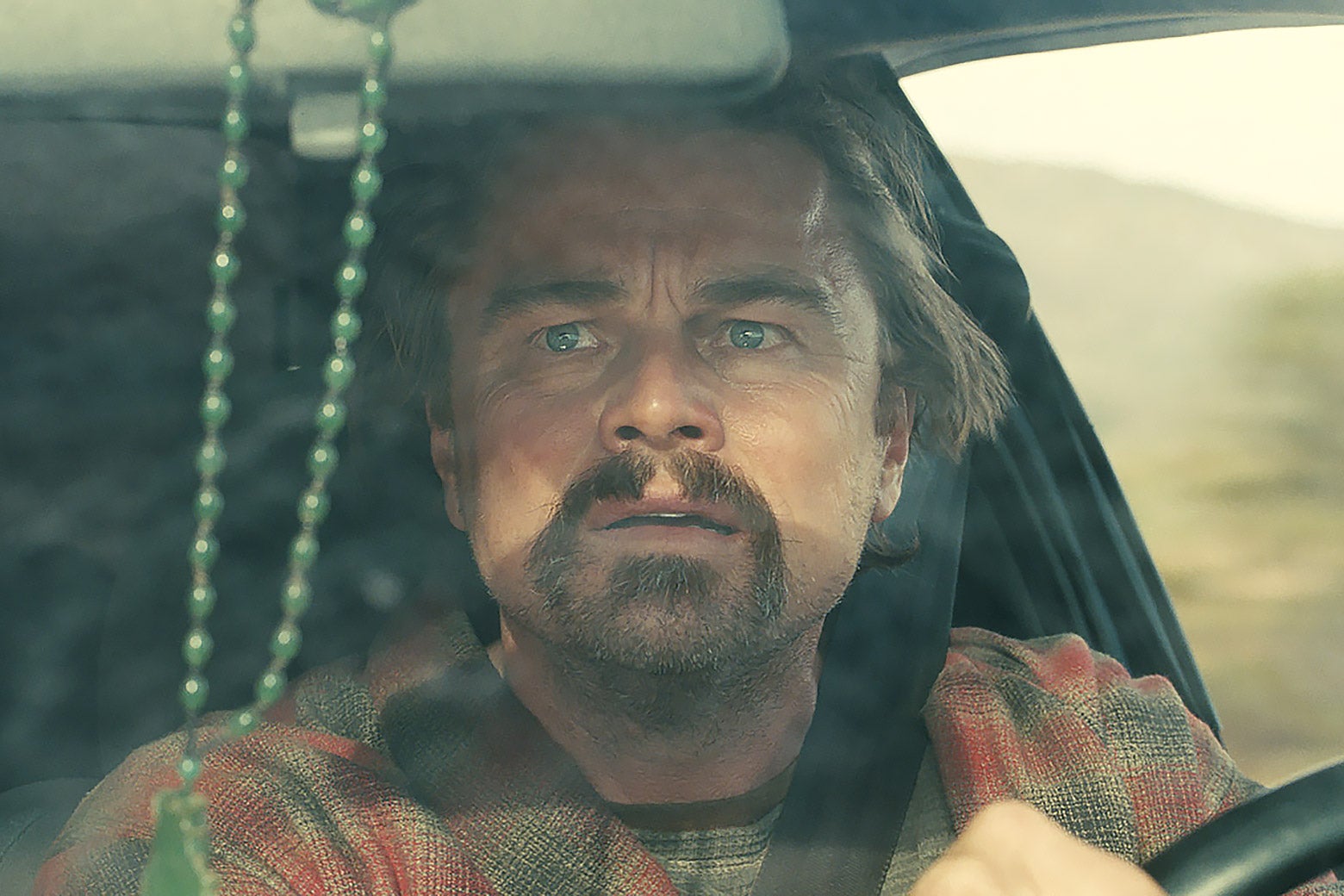
A big opening action sequence sets the adrenaline-spiking tone, while also introducing several of the many characters we’ll be following for the next 162 minutes. In an unnamed era that appears to be more or less the present day, an underground resistance network named the French 75 is infiltrating a migrant detention camp at the U.S.–Mexico border. The group’s munitions expert, a shambling hippie type named Pat, aka “the Rocketman” (Leonardo DiCaprio), rigs the explosive devices, while his girlfriend, the firebrand revolutionary Perfidia Beverly Hills (Teyana Taylor), does a sweep of the camp with gun in hand, searching for guards to disarm and restrain with zip ties. In the process, she encounters a higher-ranking figure than she expected: the sadistic and fervently racist Col. Steven Lockjaw (Sean Penn). Like many a male white supremacist before him, Lockjaw is perversely fixated on Black women—primarily because he sees them as objects to threaten and humiliate, but also, behind closed doors, because he finds them so arousing. Perfidia, immediately sensing her enemy’s weakness, engages him in a cat-and-mouse game of erotic domination and submission at gunpoint, a scene that’s at once sickening and scabrously funny.
In the months that follow the raid, Lockjaw stalks Perfidia around town, extracting sexual favors from her in exchange for protecting her identity—a two-way deal that, sordid as it is, seems to offer them both some form of gratification. After a botched bank robbery by the French 75 lands her in jail, she cuts a deal with Lockjaw to enter the witness protection program, thereby betraying the movement and abandoning both Pat and their infant daughter. With the help of big-hearted fellow revolutionary Deandra (Regina Hall), Pat and his baby assume fake identities and escape to an off-the-grid corner of far Northern California.
A 16-year time jump introduces us to Pat’s now-high-school-aged daughter (Chase Infiniti), living under the name Willa and studying martial arts with a radical activist instructor (Benicio Del Toro) who goes by “Sensei.” As for the heartbroken Pat, who now goes by Bob Ferguson, he has become a devoted single dad but also a wake-and-bake weed smoker and bathrobe-clad layabout whose paternal vigilance has congealed into jittery paranoia. Soon, the repellent Lockjaw sends his troop of goons to kidnap Willa, drawing her father out of hiding to come search for her. For the next two-plus hours, the movie ramps up into a more or less nonstop chase across the Southwestern desert, sometimes on foot, sometimes by car, switching between the experiences of the scared but resourceful Willa and the hapless yet unstoppable Bob.
Along the way, Anderson’s peripatetic script takes us on a tour of loopy subcultures: a rural convent of marijuana-farming nuns; a Masonic-style secret society built around the worship of Santa Claus; a booby-trapped apartment that Del Toro’s character describes as one link in a vast underground railroad for sheltering migrants, a “Latino Harriet Tubman operation.”
Nearly every aspect of the cruel and senseless culture of fear and repression in which these characters are struggling to survive becomes at some point a target for satire, with the exception of the unassailably good and true thing at the film’s heart: the love between a father and his daughter, and by association the inherent value of all human relationships based on love and mutual care. None of the characters in One Battle After Another come off as saintly, and the most committed revolutionary among them, the purist-firebrand-turned-absentee-parent Perfidia, is far from being the most admirable person on-screen—even if, as played by the riveting Taylor, she too is impossible not to feel compassion and sorrow for. Underneath all the picaresque action and antic humor—or, rather, woven in with them frame by frame—is a humanist parable that posits love as the only reason to keep on going.
Anderson and cinematographer Michael Bauman give the wide-screen images, shot in the near-obsolete format of VistaVision, a barreling forward momentum. There are few shots that draw attention to themselves (with the notable exception of one bravura use of overhead perspective), but the camera always seems to be just where it needs to be. Bauman also shot, with Anderson, Licorice Pizza, and like that much gentler PTA joint, this one has an exhilarating sense of kinetic freedom, with recurring images of characters running at top speed through city streets. Jonny Greenwood’s percussive, piano-heavy score gives the already suspenseful action an unsettling edge. A visual effect used in the movie’s climactic car chase seems to convert the hills and dips of a remote desert road into the steep drops of an actual roller coaster; seen on an IMAX screen, these shots are almost sickeningly intense.
“You will not be able to stay home, brother,” warns Gil Scott-Heron in the opening line of his 1970 protest anthem “The Revolution Will Not Be Televised,” a song that makes a well-timed appearance in one of this movie’s funniest scenes and later replays under the closing credits. It’s an admonition that applies most directly to the housebound burnout Bob, who, like The Big Lebowski’s the Dude before him, finds himself thrust into the role of crime-solving action hero before he can take off his ratty bathrobe. (DiCaprio has acknowledged that he took “a lot of inspiration” from Jeff Bridges’ performance as His Dudeness, and moments late in the movie feel similarly indebted to Sergio Leone Westerns and Steven Spielberg’s car-chase classic Duel.) DiCaprio and Anderson have never worked together before, but it’s hard to imagine any actor fitting better into this movie’s cracked, shambolic universe. As the actor proved in The Wolf of Wall Street, he has slapstick skills he rarely gets the chance to tap into, and the physicality he creates for the indomitable if long-sedentary Bob is a comic marvel. The newcomer Chase Infiniti (whose real-life name could be one of the Pynchonesque creations of the script) also shines in a demanding role that requires action-heroine toughness alongside profound openness and vulnerability.
But the cast’s standout, playing a villain more completely and specifically imagined than any I’ve seen in years, is the always-great but never-better Sean Penn. His Lockjaw is somehow at once a terrifying monster and a pitiable fool, with a fussy military-style strut (he wears lifts in his shoes) that tells us everything we need to know about this man’s bottomless inner insecurity, his desperate need to convince himself and everyone around him that he is the one with the power to harm others, never the reverse. Every moment Penn is on-screen signals imminent danger, yet the audience, like his teenage captive, soon sees through the flimsy sham of his overcompensating masculinity. The problem—and a very germane one it is—becomes: What do you do when the meanest, craziest, most cowardly bastard in the room is the guy with the U.S. military on his side?
Like so many things in this mysterious yet gloriously entertaining movie, the title One Battle After Another poses an enigma that it leaves the audience to solve. Does Anderson mean to say that revolutionary violence is an inexhaustible cycle, doomed to spin in place without ever moving us forward? Or is the title’s glass-half-full interpretation that we can make it through this horrifyingly dumb historical moment only by taking it one fight, one courageous decision, one invaluable fellow human being at a time? Either way, you will not be able to stay home, brother. The revolution will be live.