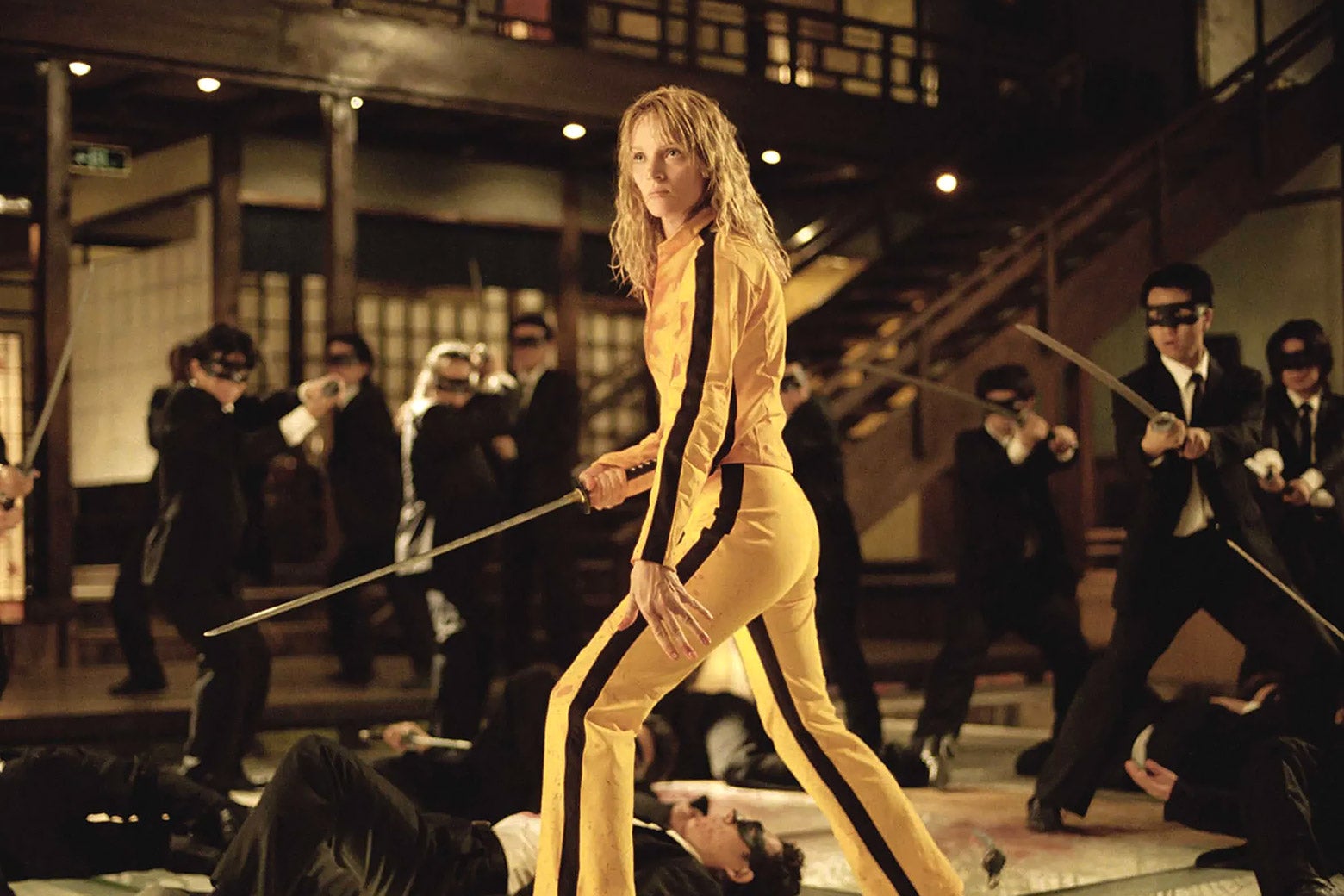
I’d seen Quentin Tarantino’s Kill Bill twice before this week: once as it was originally released, in two films six months apart, and the second time, 10 years later, as a four-hour single-film version subtitled The Whole Bloody Affair. But seeing it again this week, in an even longer version of the Whole Bloody Affair cut, I found myself brought up short by its very first shot, where the camera lingers on Uma Thurman’s battered, bloody face as a man’s voice asks from offscreen, “Do you find me sadistic?”
That line hits harder in the wake of a 2018 New York Times article in which Thurman revealed that she was seriously injured during the making of the film after Tarantino persuaded her, against her initial objections, to shoot a dangerous stunt, insisting that she drive a modified car at high speed on an unstable surface; the car skidded on the sandy road and slammed into a tree. After the accident, he sided with the film’s producer, Harvey Weinstein, in denying Thurman access to footage of the crash. “He told me,” she recalled, “that was what they had all decided.”
Although the article, whose headline proclaimed that Thurman was “finally ready to talk about Harvey Weinstein,” devoted its first half to her history with the notorious indie-film mogul who is now serving time for sexual assault, it was the second half, detailing Thurman’s relationship with Tarantino, that prompted the biggest response. In addition to putting her in physical danger, Thurman said that Tarantino had carried out some of the degradations visited on her Kill Bill character himself: It’s him spitting tobacco juice in her face, not Michael Madsen’s cowboy-hatted Budd, and when the teenage assassin Gogo Yubari wraps her chains around Thurman’s neck, it’s Tarantino’s hands pulling it tight.
Tarantino said that the latter shot had been Thurman’s idea, and Thurman graciously thanked him for finally providing her with the footage of the crash, while maintaining that the circumstances around it were “negligent to the point of criminality.” Others were less inclined to forgive. The controversy hardly dimmed Tarantino’s prospects—his next movie, Once Upon a Time in Hollywood, went on to win two Oscars and make almost $400 million worldwide—but it cast a pall over Kill Bill. It’s David Carradine’s voice asking Thurman about his sadistic tendencies, but it’s hard to watch that shot now and not think about the man behind the camera, the one brutalizing an actress’s body for entertainment.
It’s not quite so simple, of course. Tarantino wrote Kill Bill’s screenplay, but the character of the Bride—the name under which Thurman’s Beatrix Kiddo goes for the movie’s first half—is credited to “Q and U,” linking the two in the movie’s conception of a world-class assassin who tracks down and brutally murders the people she holds responsible for the death of her infant daughter. When Thurman got pregnant, Tarantino delayed the movie’s production until she was ready to shoot, and as much as it’s dedicated to paying homage to the kung fu classics and spaghetti westerns Tarantino so obviously adores, it’s also a purpose-built vehicle for Thurman’s talents, fit to her as snugly as the yellow jumpsuit in which she rains death on a yakuza nightclub. Thurman plays long, elegantly crafted dialogue scenes and spits action-movie zingers in her husky drawl; she dispatches enemies with serene badassery and goes off on crying jags so raw they’re almost difficult to endure. Few actors have ever had so generous a canvas.
As its title suggests, The Whole Bloody Affair restores numerous moments of gore cut to maintain the film’s R rating and fit it to a more conventional shape: There’s no longer any reason to fade to black-and-white before Beatrix starts splitting gangsters in two with her Hattori Hanzo sword, dousing the screen in crimson geysers. (If you ever wondered precisely what happened to Sofie Fatale’s other arm, you’re in luck.) It also doubles the length of an animated segment recounting the backstory of Lucy Liu’s O-ren Ishii, who now tracks down and vivisects all three of the mob assassins responsible for her parents’ deaths. But most importantly, it restores Thurman’s performance to a unified whole rather than presenting it in two disconnected halves, allowing us to see her career-defining work in one gloriously unbroken arc.
It was Harvey Weinstein’s idea to split Kill Bill in half, and although he may have had commercial considerations in mind, it’s hard to overlook the fact that the man responsible for bisecting her most dazzling, most vulnerable performance is also the one whose crude and forceful sexual advances she was forced to reject on more than one occasion. You can imagine a touch of Beatrix’s ice-cold resolve as she recalls what she told him after the last time: “If you do what you did to me to other people you will lose your career, your reputation, and your family, I promise you.”
Weinstein was famous for his ability to bend the academy to his will, and after getting Tarantino his first Oscar and Thurman her first nomination for Pulp Fiction, he must have known that Kill Bill had the potential to put Thurman over the top, garnering her what would have been—what would, in fact, still be—her only Best Actress nod. Instead, not knowing what to do with either half of the film, the Oscar voters of 2003 and 2004 ignored both, making the Kill Bills the only solo Tarantino features since Reservoir Dogs to go without a single nomination. If anyone could have foreseen that consequence, it was Weinstein.
It’s not just watching in a single sitting that makes the majesty of Thurman’s performance evident. It’s the reversal of a change Tarantino made to the very end of Vol. 1, one of the smallest but also the most consequential differences between the two-part Kill Bill and The Whole Bloody Affair. The movie’s plot kicks into motion when Bill (Carradine), who is both Beatrix’s ex-lover and her ex-boss, orders the execution of Beatrix at her own wedding rehearsal, along with the deaths of anyone else unlucky enough to be inside that dusty Texas chapel at precisely the wrong moment. The gunfire also kills the child in Beatrix’s womb, and while she’s presumably upset about the murder of her fiancé and all of their friends, it’s clear that loss is what’s fueling her exceptional lust for revenge. So it’s quite a shock to get to the end of Vol. 1 and learn, via the voice of the still-unseen Bill, that Beatrix’s child is still alive, and the orgy of destruction we’ve been watching her undertake is premised on a huge mistake.
For viewers of Vol. 1, that revelation served as an enticement for viewers to come back in six months for Vol. 2. But The Whole Bloody Affair needn’t dangle such a carrot. And while the movie does still take a break at the same point—its 275-minute run time includes a 15-minute intermission—the audience now learns the truth at the same time Beatrix does, roughly three and a half hours in. She’s been beaten and bruised, shot at and stabbed, ripped out eyeballs with her bare hands and punched her way out of a coffin buried deep in the earth, only to arrive at Bill’s door and find him playing papa with her 4-year-old daughter. By that point, in this version, we’ve been riding shotgun with Beatrix the whole way, and though the movie mouths the occasional platitude about the emptiness of a life consumed by vengeance, we’re as invested as she is in seeing Bill’s head go kablooey. But finding out that the person whose death she’s been seeking to avenge is still very much alive turns that calculus inside out, and muddles what ought to be a joyous reunion with feelings of shock, and, at least for the audience, disappointment.
By then, it’s clear that Bill is one in a long line of men who have subjected Beatrix to some form of degradation, from the sleazy male nurse who rapes her while she’s in a coma to the martial arts master who humiliates her before teaching her his most deadly techniques. Sometimes, she accepts that degradation as an inevitable cost of ascending to a higher level, which also seems to be the spirit in which Thurman approached the making of Kill Bill. “I had really always felt a connection to the greater good in my work with Quentin,” she told the Times in 2018, “and most of what I allowed to happen to me and what I participated in was kind of like a horrible mud wrestle with a very angry brother.” And that places the movie in a troubling lineage of its own.
There’s a small but complicated canon of enshrined classics whose female leads were subjected to on-set conditions that under any other conditions would clearly register as abuse. Björk’s wrenching performance as a struggling factory worker in Lars von Trier’s Dancer in the Dark won her Best Actress at Cannes, but the process of making the movie was so traumatic she vowed never to act again. (“Lars, who is a complete fanatic, wants his figures to suffer,” she explained, “especially the female ones.”) Last Tango in Paris’ Bernardo Bertolucci and Marlon Brando hid the nature of a scene involving violent sexual assault from 19-year-old Maria Schneider until just before they shot it, leaving her no chance to object; Schneider said decades later that she “felt a little raped.” Darren Aronofsky sprung the climax of Mother, in which the title character’s baby is ripped apart and eaten by an angry mob, on his lead actress and then-girlfriend, Jennifer Lawrence, without warning, apparently unconvinced that Lawrence, an Oscar winner and four-time nominee, could muster the desired shock without being tricked into it. At the film’s North American premiere, standing a few feet from Aronofsky, she described it as “the worst feeling I’ve ever had in my life.” (They broke up shortly thereafter.)
The French director Jacques Rivette argued that every movie, no matter how fictitious, is in part a documentary of its own making, a record of what happened on the set. So when you’re watching Beatrix Kiddo speed down the road toward Bill’s house, you’re also, inevitably, watching Uma Thurman in the moments before an accident that could easily have paralyzed or killed her, placed there by a director who didn’t like the way her hair looked at safer speeds. That might change the way you think about Tarantino, or even Thurman, who, when her daughter Maya Hawke asked about taking a part in Tarantino’s Once Upon a Time, said her only advice was to keep her shoes on. But should it change how we feel about Beatrix Kiddo, or about the years Thurman put into creating her?
Ultimately, I think the best way to honor the ordeal that Thurman endured is to honor the work it produced. Directors may be the authors of a film, but they’re not the only ones, and Thurman’s achievement shouldn’t be eclipsed by her former collaborator’s misdeeds, any more than Sarah Michelle Gellar should lose the years she put into Buffy the Vampire Slayer because its creator turned out to be a faux-feminist creep. Feel free to roll your eyes when the film’s villain pauses the action to deliver a lecture on the semiotics of Superman comics. But keep them pinned to Thurman and you’ll see a performance for the ages.