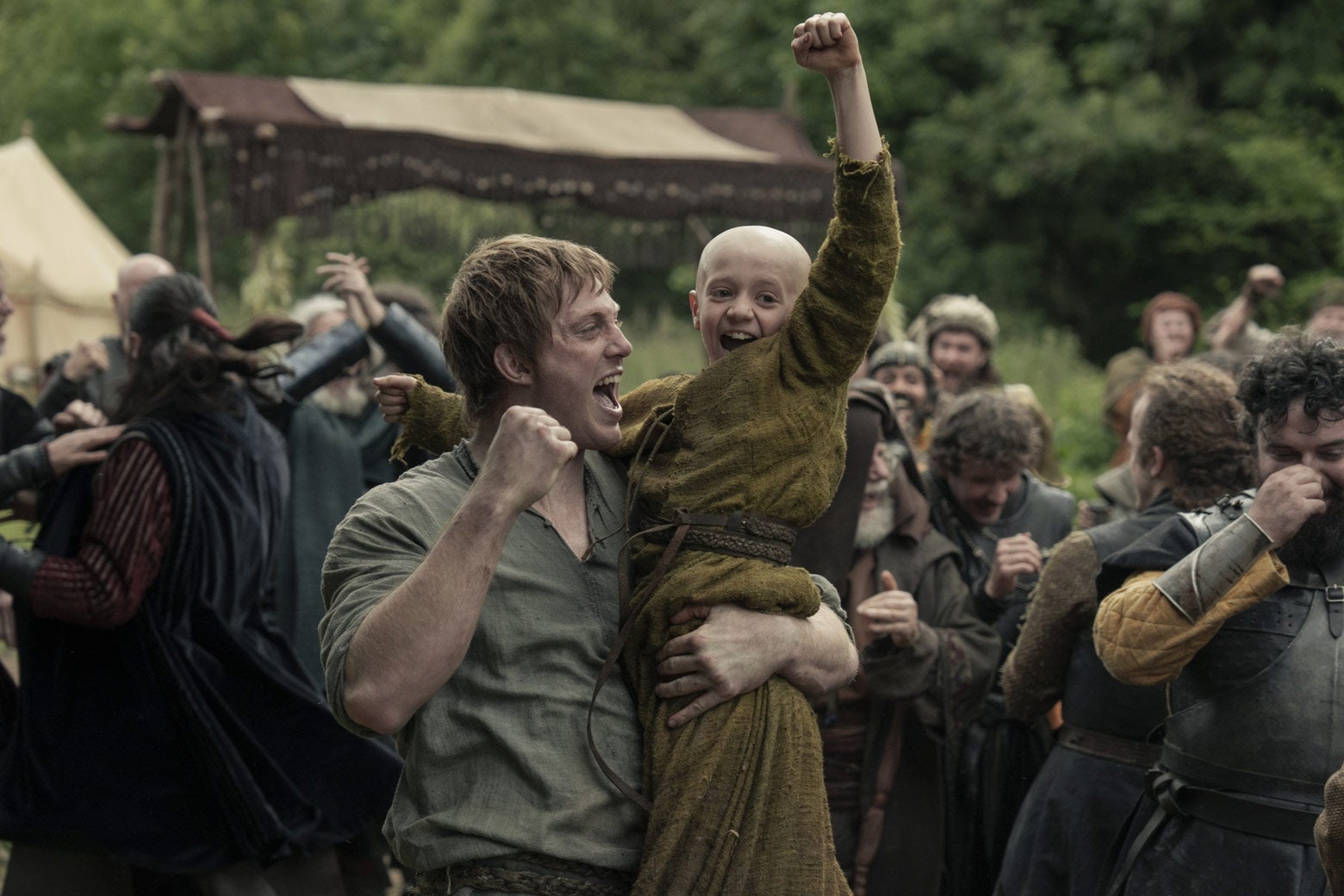
The people behind HBO’s A Knight of the Seven Kingdoms, the first season of which premieres Sunday night, have performed something of a miracle. The shorthand way to describe what A Knight of the Seven Kingdoms is—a Game of Thrones show that’s a half-hour-ish comedy—doesn’t quite convey what watching this show feels like. We’ve still got all the blood, shit, vomit, and flies, the tactile, fleshy medieval milieu that Game of Thrones and the embattled prequel House of the Dragon accustomed us to enjoy. Members of the major houses of Westeros make appearances, and there are evil, grinning princes to hate, even combat scenes with crunching sounds that will make you wince.
But what’s missing is all the dreadful heaviness you risk when you set out to get into a George R. R. Martin adaptation. It’s been siphoned out, as if by the hand of the most decorated maester. Somehow, Knight is all the better for it, a Game of Thrones show that everyone can enjoy, even those who flinched from its predecessors.
This story is adapted—mostly directly, with some small departures that are mostly improvements—from the first of Martin’s Tales of Dunk and Egg novellas, The Hedge Knight, first published in 1998. You can read this one, bundled with the second and third, in a volume called A Knight of the Seven Kingdoms. Martin says he has more ideas for novellas beyond the third, but promised in a blog post last year that he would not give us more Dunk and Egg until he finishes The Winds of Winter, the near-mythical next volume in the main A Song of Ice and Fire series—a stipulation sure to trigger a long-suffering chuckle from any fan of this particular IP.
The Dunk and Egg action takes place after the end of House of the Dragon, and before the beginning of Game of Thrones—when Targaryens are still sitting the Iron Throne, but all of the actual dragons are dead. There’s some talk of past wars, and politicking around the merits of different families and princes. But these questions of state barely matter, except insofar as they affect the life of Dunk, our brawny, innocent hero, who was born in Flea Bottom, the poorest neighborhood in King’s Landing.
Dunk (played by the Irish actor Peter Claffey, a former professional rugby player) escaped Flea Bottom in his youth only because he crossed paths with Ser Arlan (Danny Webb), an elderly hedge knight who takes Dunk on as a squire. The series opens with Arlan’s death, and, armed only with their three horses, his unusually large size, an all-encompassing belief in the chivalric precepts of Westerosi knighthood, and his insistence that his late mentor knighted him as a final act, Dunk is on his own. Hedge knights are a somewhat degraded class in Westeros ( “like a knight, but sadder,” says one character in the show’s first episode). They serve no house, but go from lord to lord, as gigs arise. After the death of Ser Arlan, Dunk, being without any connections, or even a proper belt to hold his scabbard, must hack away around the edges of Westerosi society. To earn some coin, he will enter tourneys to joust for screaming audiences, or go fight wars that have nothing to do with him.
And so, in this first season of the show, we find Dunk arriving at a tourney at the town of Ashford, in the Reach. He’s acquired a mysteriously bold-mouthed and bald little boy (Dexter Sol Ansell), named Egg, as his squire. Despite not really being good at talking (the character’s first line in the series is “I don’t know the right words”), Dunk is, always, pure of heart. As he convinces the lords to let him participate, gets closer to Egg, and makes friends in camp among certain highborn men who find his naïvete and large size a pleasurable novelty, you’re more and more Team Dunk. Puppet shows, wild parties in lords’ pavilions, and the violent pageantry of the jousting itself are all visually rich, scratching that classic Game of Thrones itch.
A hero with ethics and morals, who rises from nothing, to be known by lords and princes? A sweetie, who says to his dead father figure, “I wish you didn’t die, ser,” and promises to take good care of the horses? A strong boy, at constant risk of exploitation in the bloody and cynical world of Westeros? (A sex worker in this first episode describes their situations as similar: they both put bodies “at hazard for the pleasure of strangers.”) This is exactly the kind of person Game of Thrones would offer up for our emotional investment, only to yank them away, by beheading, Red Wedding, or hodor, hodor, hodor-ing, when we’d get too attached.
The difference is, this time, we know that Dunk will stay around. These are the Dunk and Egg novellas. Not only will the character not die, he’ll be our focus. No switching back and forth between rival queens, or glimpsing Arya Stark for 10 precious minutes out of the week’s hourlong episode, before having to say goodbye again. And the contrast between Dunk’s purity and Westeros’ underlying corruption offers comedic possibilities, but also great scope for exploration. We can tour the realm, get reacquainted with the distinctive rhythm of Westerosi speech and the politics of the great houses, enthrall ourselves with the possibility of glimpsing what the Baratheons and Starks were up to before Game of Thrones kicked off, all without fear of our hearts suddenly breaking. I feel thick as a castle wall saying this, but what a relief! A Game of Thrones show, with the pressure off? I’m in.