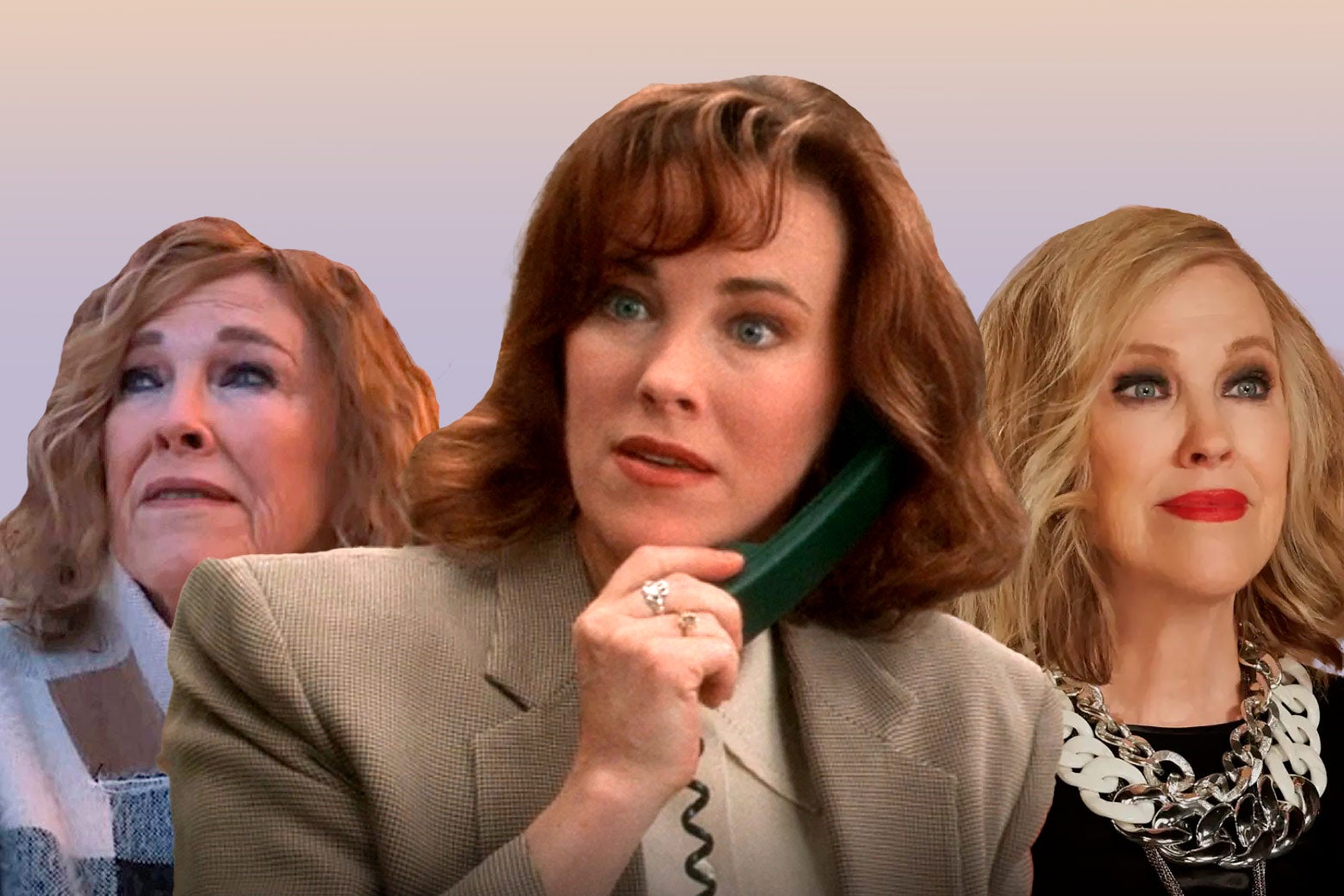
There’s a moment at the end of Home Alone that only works because of Catherine O’Hara. After her character, Kate McCallister, has endured a hellish journey from Paris to get back to her son in Chicago, she finally makes it home on Christmas morning. She wanders around the house, looking frantically for Kevin (Macaulay Culkin) and yelling out his name. But when she finally finds him, she pauses. We see her seeing him. She’s been screeching for much of the film, but now her voice becomes quiet and soft. She smiles and wishes him a merry Christmas. It seems for a moment as if Kevin won’t forgive her for accidentally abandoning him before the family vacation, and you can briefly see the pain on her face. But then he smiles and runs into her embrace. How could he not? This is his mother.
O’Hara seemed to glow in that movie, even when she was a ball of stress getting ready for the airport, even when she screamed her son’s name in a panicked moment of realization that would become one of cinema’s most memorable yet briefest lines. There was an aura around her, a warmth, perfectly captured by her red hair and tan coat. When Kevin runs into her arms, we’re reminded that despite all the cunning and bravery he used to outwit the home invaders, he’s still just a little boy who missed his mom. He squeezes her in a hug that feels as if he may never let go. She squeezes right back. Her love for her son has propelled her across the world, through snow and sleet, in airplanes and the backs of moving vans. Her hug tells him that, despite all the chaos, he is not forgotten—that he is loved. This was the source of her warmth. No wonder Culkin, even decades later as an adult, still called O’Hara “mom.” In that moment, she feels like our mother too.
It’s perhaps understandable then why O’Hara’s sudden passing at the age of 71 on Friday, after a brief, unspecified illness, seems to have hit so many of us like a gut punch. On the backs of the no less shocking deaths of Diane Keaton and Rob Reiner, two other Hollywood giants who felt almost like parental figures to many of us who grew up on their work, this loss feels personal. Many millennials simply can’t remember her not being on our screens. There she was as we aged, appearing across films and TV that felt like markers of time and building blocks of our lives. This was Delia from Beetlejuice. This was Sally from The Nightmare Before Christmas. Moira from Schitt’s Creek. The comic genius from seemingly every Christopher Guest movie. Kevin’s mom. As my social media feeds were flooded with tributes to O’Hara from seemingly everyone on Friday, it felt as if I was witnessing near universal adoration. She was beloved.
O’Hara was a master at preying on your perceptions of her for laughs. She knew she appeared small, which is why she prized parts that let her play to the rafters. For my money, that explains why her best work was always with Guest, the mockumentarian who encourages such big swings; think of how she played drunk as Sheila Albertson in 1996’s Waiting for Guffman and asked a dinner guest what it was like to be with a circumcised man, or how she sang a tribute as Cookie Fleck in 2000’s Best in Show to her patient Norwich terrier with on-screen husband Eugene Levy, her frequent acting partner. She could weaponize that voice of hers. Who else but O’Hara could find syllables and intonations you didn’t even know existed as she extolled the virtues of Herb Ertlinger’s fruit wines?
O’Hara’s warmth and humor were so palpable that they often felt present even when she was playing dramatic roles. You could tell her castmates were enjoying her company as much as we did watching her. It didn’t strike me as odd that the first star I saw pay tribute to O’Hara on Friday was Pedro Pascal, who acted across from her in the dark second season of The Last of Us. “Oh, genius to be near you,” he wrote. “There is less light in my world.”
Somehow, it always felt like O’Hara’s best work was still ahead of her—like she somehow wasn’t done. The second wind that Schitt’s Creek seemed to bring her—she won an Emmy for the show in 2020—also gave us her brilliant recent turn as an ousted executive in The Studio, for which she’s deservedly nominated for another one. Her death has cheated us of all the great parts she was yet to play and all the laughs she was still to give us.
I got to interview O’Hara once. It was 2018, and Schitt’s Creek hadn’t yet become the gargantuan hit it would be once the show finally took off on Netflix. So it felt like I was letting the world in on a secret with a story in which I dubbed her cooing and couture-wearing matriarch one of the best-dressed characters on television. She’d graciously agreed to give me an interview, not because she knew I’d be bestowing that moniker but because she’d wanted to spotlight the work the show’s creative team had done in helping her build Moira’s style.
I can still conjure the moment when I first heard her over the speakerphone. Suddenly, there I was, alone in a small office breakout room, with that voice—that soft, lilting, distinctly Canadian voice. She sounded exactly like you’d expect, of course, but also surreally casual, which made hearing her feel almost casually surreal. This was the voice of Moira and Kate and Cookie. It was the voice of one of the funniest people who has ever lived. It was the voice of a woman who’d raised me.