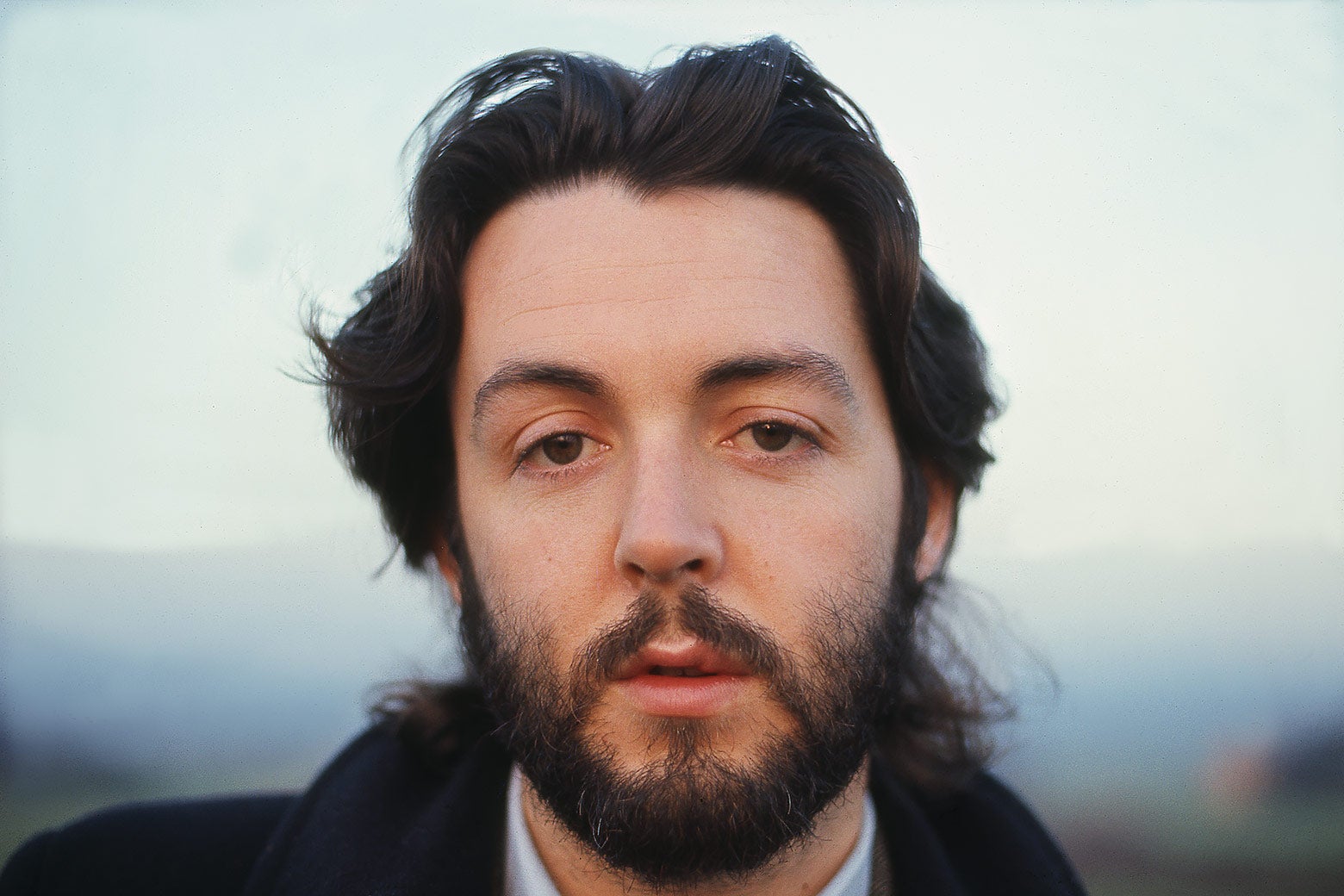
Seeing as he’s now in his mid-80s and currently enjoys near-universal approval ratings, it might be hard to believe that once upon a time Paul McCartney was one of the most polarizing figures in popular music. Paul is inarguably one of the most important artists in the history of rock music—as a singer, a songwriter, and an instrumentalist—and yet for a long period, he was vociferously loathed by many of that music’s most rabid fans. As far back as the late 1960s, he was rumored to have died and been replaced by an impostor, in what remains one of the strangest (and most strangely enduring) conspiracy theories in popular culture. In 1970, he was widely and unfairly blamed for breaking up the Beatles, then further vilified for taking his former bandmates and their management to court. His early solo albums were panned by critics, and his first attempt at a post-Beatles band, Wings, was a commercial juggernaut that never beat the allegations of not being the Beatles. (For what it’s worth, no other band in history has beaten those allegations, either.)
Morgan Neville’s new documentary Man on the Run is an unusually thoughtful and probing look into McCartney’s tumultuous 1970s, the decade when the enmity described above was probably at its most frothing. Paul and his family participated in the making of the film and are frequently heard from through off-camera interviews (supplemented with archival audio from Paul’s late wife and Wings collaborator, Linda), but the film isn’t a hagiography or a whitewash—both Paul and Neville are smart enough to know that its subject deserves better than that. Instead, it’s a fascinating and surprisingly unflinching look at McCartney’s extended attempts to find his way into something resembling both musical and personal adulthood.
Man on the Run effectively begins with McCartney’s eponymous first solo album, the release of which publicly announced the official dissolution of the Beatles, even though John Lennon had already told his bandmates he was leaving the group. McCartney sold well but was largely pooh-poohed by critics as a half-baked trifle, despite containing the staggering “Maybe I’m Amazed.” McCartney followed it up with 1971’s Ram, an experiment in DIY, low-fi recording that was savaged upon its release: “Ram represents the nadir in the decomposition of Sixties rock thus far,” opened Rolling Stone’s review. (Today Ram is considered a landmark of its kind, a crucial precursor for what would come to be known as indie rock, and one of the most influential albums of its era.)
Both McCartney and Ram were billed as McCartney solo albums, and on the former, that was almost true in the most literal sense of the word: Paul played every instrument himself. (Linda did contribute background vocals.) But by the early 1970s, Paul was beginning to miss being in a band, and thus began the project of assembling Wings, which released its debut album, Wild Life, in late 1971.
The lion’s share of Man on the Run is devoted to the Wings years, and it’s a welcome spotlight on one of the most contentious and overdetermined bands of the 1970s. Wings were never nearly as bad as their legions of detractors claimed, nor were they as good as some of their revisionist defenders insist. They made one absolutely great album and a handful of good-to-excellent singles, but their output was mostly uneven and often seemed to lack a coherent focus or a sense of what Wings even was, a quality likely exacerbated by the fact that, aside from Paul, Linda on vocals and keyboards, and guitarist and multi-instrumentalist Denny Laine, the band was something of a revolving door. (In the documentary, someone remarks that Wings went through so many drummers that they invented Spinal Tap.)
That one great album, which inspires the title of Neville’s film, is Band on the Run, Wings’ 1973 masterpiece that is one of the very best “solo” projects any former Beatle was ever associated with. Band on the Run was a blockbuster hit that also managed to (temporarily, at least) put Paul back in the good graces of many of the critics who’d scorned his prior post-Beatles work. It’s an album so good that the rest of Wings’ output suffers in comparison: Why couldn’t this band have just been this good all the time?
It’s a good question and needn’t just be a rhetorical one. One potential answer is that, as Man on the Run details, Band on the Run is closer to a Paul McCartney solo album than any other Wings album. The plan was for Wings’ original lineup of Paul, Linda, Laine, drummer Denny Seiwell, and guitarist Henry McCullough to travel to Lagos, Nigeria, to record the album there. Shortly before departing, Seiwell and McCullough abruptly quit the band, chafing under poor pay and Paul’s penchant for good-natured dictatorialism. Their departure meant Paul was forced to play drums and most lead guitar himself, along with the bass and a lot of the keyboard parts.
This necessity produced some of the most inspired and adventurous musicianship of McCartney’s long career. Leaving aside the fantastic songwriting and vocal performances on Band on the Run, McCartney’s drumming on the album is some of my favorite in the entire rock canon. “Let Me Roll It,” a track on which Paul plays almost everything, is one of the great soul tracks of the 1970s, in no small degree due to the interplay between drums and the lead guitar’s indelible riff, both of which were played by Paul. The acoustic guitar that explodes into the main section of the album’s title track, which to my ears is on the very short list of the best-sounding acoustic guitars ever recorded: That, too, was played by Paul. Freed from his self-imposed obligations of musical collectivism, Paul was finally able to indulge his secret desire to basically do everything himself, a desire he was always loath to openly express but had long had a tendency to plague his relationships with those with whom he was supposed to be collaborating.
Indeed, of the most fascinating tensions that pops up again and again in Neville’s film is Paul’s deep attraction to collaboration, to the emotional satisfaction of being part of a band, and how this yearning is sometimes irreconcilable with his own enormous talent. This, of course, won’t be news to anyone who knows anything about the final years of the Beatles, or who’s watched Peter Jackson’s documentary Get Back. Paul’s otherworldly musical virtuosity could have a tendency to undermine the solidarity of the Beatles as a collective, particularly by the time of the Get Back sessions, and seems to have clearly grated on some of the (many, many) members of Wings over the years. One can only imagine it’s a strange experience being a world-class session player (which many of the members of Wings were) and finding yourself a band with a guy who not-so-secretly thinks he can play your instrument better than you can—and is probably right.
Someone this tension wouldn’t have much impacted was Linda McCartney, who’d had no professional musical experience before Paul recruited her to perform on his records. Yoko Ono is such a monumental cultural figure that the extremely well-known and ugly history of Yoko discourse can sometimes overshadow just how shabbily Linda McCartney was also treated over the years, and never more so than during Wings’ heyday. Her singing ability was openly ridiculed, her keyboard playing dismissed out of hand. (There were persistent rumors in the 1970s that her instruments weren’t even plugged in.) Even as a kid in the 1990s, I remember hearing jokes at Linda McCartney’s expense that were so cruel that I wouldn’t repeat them here.
All this was obviously drenched in misogyny and a rock culture that had always been chauvinistic but reached new depths in the 1970s. Led Zeppelin would never put their wives in the band, you can almost hear someone sneering. But many of Man on the Run’s most moving segments are devoted to Linda, a fascinating figure who was already a highly accomplished photographer when she married Paul, and someone who never seemed entirely comfortable in the spotlight that was the inescapable price of marrying a Beatle. She was coaxed into Wings by Paul, because he loved her and wanted to share the experience of making music with her, and because he didn’t want to be away from her and their kids while on tour, and for years they somehow made this work in the face of inexplicable amounts of derision. In Man on the Run, the McCartneys’ children speak of her in almost awed tones, marveling at how she managed to hold together an unusual but fiercely devoted family in the face of relentless scrutiny. Man on the Run might be a movie about Paul, but at its best, it feels like it belongs to her.