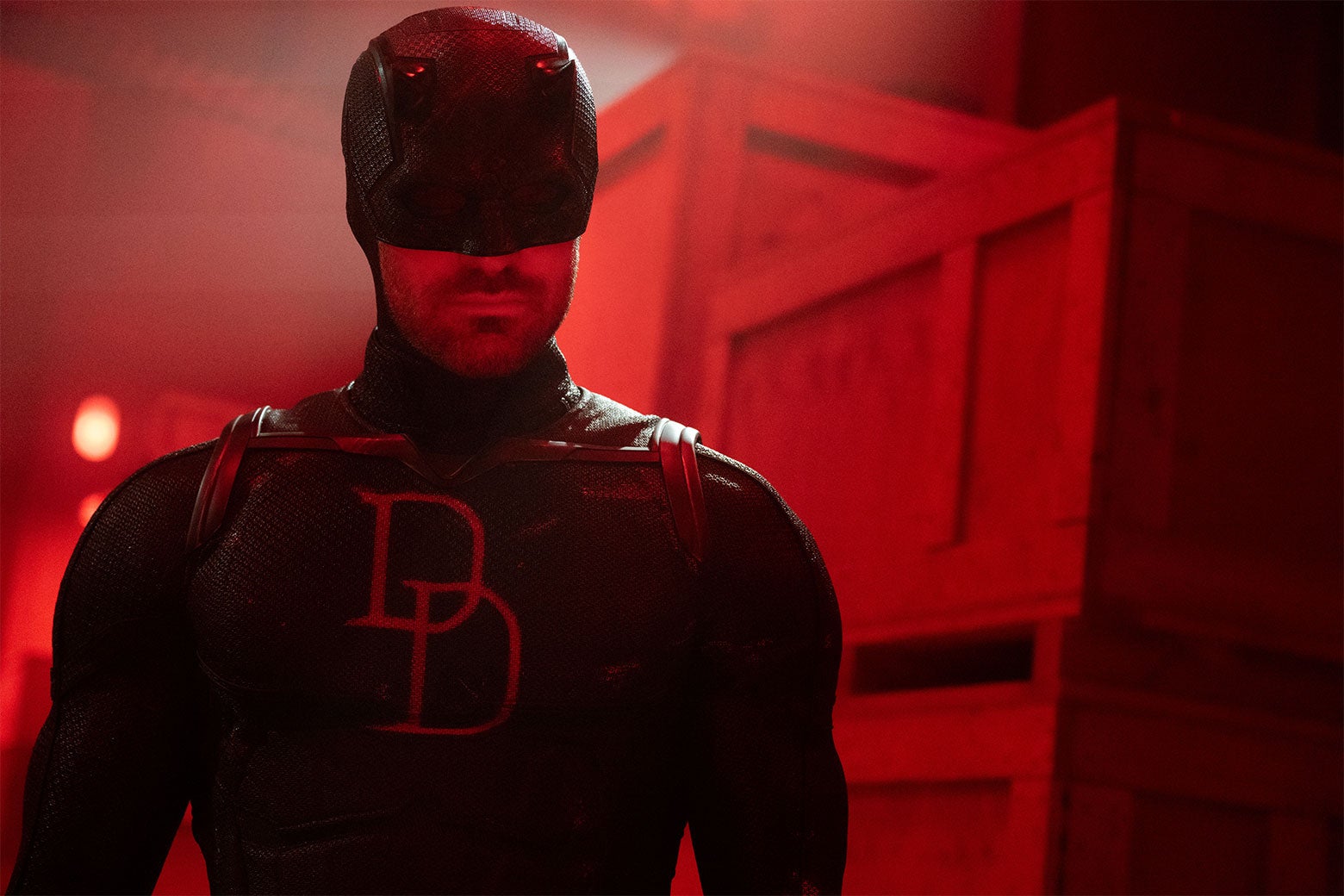
In the newly debuted second season of the Disney+ series Daredevil: Born Again, a corrupt, criminal mayor has created and empowered a new branch of law enforcement loyal only to him. These agents, who are more soldiers than cops, were commissioned on exaggerated, baseless claims. They are valorized in soft-focus propaganda videos. They are also totally, definitely not ICE. In the fiction of Daredevil, these goons are called the Anti-Vigilante Task Force, and they are unquestionably terrible. But viewers aren’t stupid. Unless your head has been resolutely planted in the ground for years now, it’s clear what the AVTF is modeled after: They’re Marvel’s Immigration and Customs Enforcement.
Of course, Marvel would not put it this way. “Any kind of reflection on reality is coincidental, but Stan Lee said Marvel reflects the world outside our window,” Marvel Television chief Brad Winderbaum told Variety at the Daredevil: Born Again Season 2 premiere a week ago. “Sometimes things just take on a life of their own.”
Winderbaum’s quote isn’t entirely spin. Daredevil: Born Again’s second season was written years ago, and went into production immediately after the first season premiered last March. That first batch of Born Again episodes established the series as one that is interested in being a more timely and pointed take on Marvel’s superhero fare, with blind lawyer Matt Murdock’s (Charlie Cox) long feud against the crime boss Wilson Fisk (Vincent D’Onofrio) taking a new shape after Fisk is elected mayor of New York City. This was, as Winderbaum would put it, another “world outside your window” moment, evoking Donald Trump’s first term, the administration’s hostility to immigrants, and an emboldened, corrupt police force—likely represented by the AVTF to, ironically, avoid accusations of Born Again being anti-cop.
One year later, and Born Again’s extension of its AVTF plotline has mirrored the expansion of ICE’s role in governance. In AVTF’s broad mandate to rein in vigilantism, the task force has run a wide net across the city, scooping up citizens on a whim, hauling them off to a secret black site hidden on a Red Hook pier. They keep these detainees—only one of whom, played by Tony Dalton, is a confirmed vigilante—in cages and ignore their pleas. They openly serve the mayor’s interest, not the public, and are happy to intimidate and even kill people who might compromise the mayoral agenda, like Matt Murdock/Daredevil’s friend, the private investigator who goes by Cherry (Clark Johnson). The AVTF’s jackbooted entitlement, its smug hostility, has parallels in countless videos shared of ICE aggression over the last year, and Born Again’s parallels to the current moment make it a more compelling show than it would be otherwise.
That fact would follow fiction here would have been a trivial prediction to make; authoritarianism, as history has made clear, tends to move in prescribed ways regardless of how it creeps in. More thorny, however, is how freely we can talk about this. Marvel’s reluctance to really lean into its own show’s on-the-nose relevance recalls recent statements made by Tony Gilroy about the promotion of his Star Wars show, Andor, which follows a petty thief who becomes a revolutionary against the overreaching Empire. According to an interview in the Hollywood Reporter in February, Disney asked Gilroy to refrain from using the word “fascism” in his promotion of the show, despite his very blunt and notably anti-fascist approach to the subject. (“You get out your Fascism for Dummies book for the 15 things you do, and we tried to include as many of them as we could in the most artful way possible,” Gilroy told THR.)
It’s not just Disney, either. Earlier this month, Episode 11 of HBO Max’s second-season hit The Pitt tossed ICE agents into its volatile medical drama, with the armed goons escorting a detainee into the show’s emergency room, denying her any phone calls to loved ones, and demanding the doctors treat her injury (said to be from a fall, strongly implied to be from their manhandling) so they can process her. The presence of the ICE agents takes up all the oxygen in the episode, both for the viewer and for the show’s cast. Staff and potential patients start leaving when they learn ICE is in the building, fearing for their own safety, and the ICE agents’ brusque, entitled attitudes make the doctors’ job of actually tending to their patient nigh impossible. No one makes any principled stances beyond a heated dressing-down from protagonist Dr. Michael “Robby” Robinavitch (Noah Wyle) about how all patients, documented or not, deserve the same standard of care. But Dr. Robby’s posture towards ICE is ultimately one of pragmatism—he wants his staff to comply so that ICE gets out of there.
It is, all things considered, a mild criticism of ICE and its function. The Pitt’s writers and producers found it better to show, not tell, with the agents’ overall disruption to every aspect of its cast’s life-saving mission being the real statement, not any speech made by any one character. But what is remarkable about it is the way it’s been treated as a dazzling act of defiance. “I can say that all of us are approaching what’s going on in this country right now with a certain trepidation, and also awareness that there are some possible risks to telling certain kinds of stories,” The Pitt producer John Wells told the Daily Beast in the lead-up to Episode 11’s premiere, noting that HBO execs’ only note for him was to “make sure it’s balanced.”
In hindsight, this feels like canny damage control. The ICE plot isn’t really interested in any both-sidesisms. What it is instead is measured, careful, isolated. The ICE story enters the show, The Pitt gets to spin a mild fable about its reckless damage to the social fabric, and then ICE leaves, the only lingering plot thread being a nurse who is sent to a detention center for daring to interfere with an ICE agent accosting the detainee.
This reluctance to fully own the brutal realities that these shows are taking pains to depict is untenable. The notion that it is somehow dangerous to plainly reflect what is being reported on in national news and shown on social media feeds everywhere is deleterious to the culture, evidence of how this censorious administration has already caused the purveyors of our biggest mass media—these are Disney shows and a hit medical drama—to walk on eggshells, and divorce their work from the context in which audiences will experience them. These shows’ creators have already assumed some level of risk through portrayals of authoritarianism; what will it take for them to say so explicitly, instead of hemming and hawing around the truth so as not to scare away shareholders?
The longer this lamentable state of affairs persists, the worse it will get. From the theatrics of costumed superheroes to grounded procedurals and countless modes of entertainment in between, the fraught relationship between the public and law enforcement is a foundational wellspring of storytelling. That relationship has changed measurably, especially in recent years, and any attempt to tell stories with any kind of relevance will have to reckon with that. To refuse to do so by feigning coyness is to embrace delusion, and to play exclusively to the narrow audience of vain government officials and executives looking to get mergers approved, not the public. And people can tell when you are playing for another audience entirely. They’ll watch something else instead.