Oh, Norway, is it the long winter nights and oil-wealth-fueled decadence that have transformed so many of your citizens into freakish perverts? Or is it just the imagination of Jo Nesbø, the country’s most successful—and, therefore, most representative—author to date? Nesbø, who has sold tens of millions of thriller novels mostly starring the Oslo police detective Harry Hole and often featuring grotesquely creative serial killers, has had poor luck bringing his work to the screen. His breakthrough novel, 2007’s The Snowman, was adapted as a 2017 movie starring Michael Fassbender as Hole, a notorious mess of a film due to the production failing to shoot 15 percent of the script. That story involved a maniac targeting unfaithful wives and building snowmen at the crime scenes incorporating body parts of the victims.
Detective Hole, a new, Norwegian-made Netflix series based on Nesbø’s fifth Harry Hole novel, The Devil’s Star, is a handsomely shot and expertly acted production that tends to highlight the weaknesses of Nesbø’s fiction—all of which can be soundly attributed to Nesbø himself, given that he’s the show’s sole writer. His novels boast fast, intricate, twist-filled plots and plenty of action, all fine qualities that explain their success. But condensing such a narrative into nine episodes will almost inevitably make it a more wobbly construction, and Nesbø has done little to mitigate the story’s many absurdities.
Harry Hole—whose name is an accidentally crude English pun, or perhaps an intentional one; it’s hard to tell with an author who also penned a children’s book titled Doctor Proctor’s Fart Powder—is your basic macho, humorless brooding-loner action hero with a tragic past. Played by Tobias Santelmann, Harry’s primary character trait is his alcoholism, which he seems to be able to turn off and on at will. The death of a colleague (unfortunately, the most appealing character in the show) early in the series triggers a relapse that jeopardizes Harry’s long-term on-and-off relationship with Rakel (Pia Tjelta), a single mother whose son has begun to form a filial attachment to the detective. So Harry has lots to feel guilty about. Despite the booze-soaked depression he falls into, and the fact that he seems to spend all of his free hours smoking moodily on the terrace of his high-rise apartment, the TV version of Harry maintains a meticulous one-eighth-inch five-o’clock shadow at all times and an exquisite, often-shirtless physique that could only be the product of a strict keto diet and daily sessions at the gym.
The one thing that can mobilize Harry out of this funk is, of course, an urgent puzzler of a case. A serial killer has been going around murdering apparently random women, placing star-shaped diamonds on their bodies and cutting off one finger from each corpse. Also, the murderer carves pentacles at the crime scenes, leading Harry to visit a priest to ask what the symbols mean, something that seems a bit clueless for a guy who’s supposed to be an expert on serial killers after studying the subject in (naturally) the U.S. In a related, or perhaps directly linked, plot, Harry suspects another detective, Tom Waaler (Joel Kinnaman), of being responsible for their colleague’s death and other nefarious deeds.
With the exception of a few harmless, congenial older dudes, virtually every adult male character besides Harry in Detective Hole is creepy. The supercilious neighbor of one of the victims quotes Heidegger and claims that the murdered women were “promiscuous” and “not exactly free from sin.” Later, his wife confesses to Harry—after a (failed) attempt to seduce the detective—that he demands that she make no sounds or movements when they have sex. A witness, asked to describe a bike messenger who likely committed one of the murders, insists that he doesn’t “study the bodies of other men,” in a way that makes you think exactly the opposite. One of the victims, an actress, is married to a theater director who gives every madly blinking sign of being gay and breezily explains over lunch: “Lisbeth and I enjoyed the act of postilion. She finger-fucked me in my ass.”
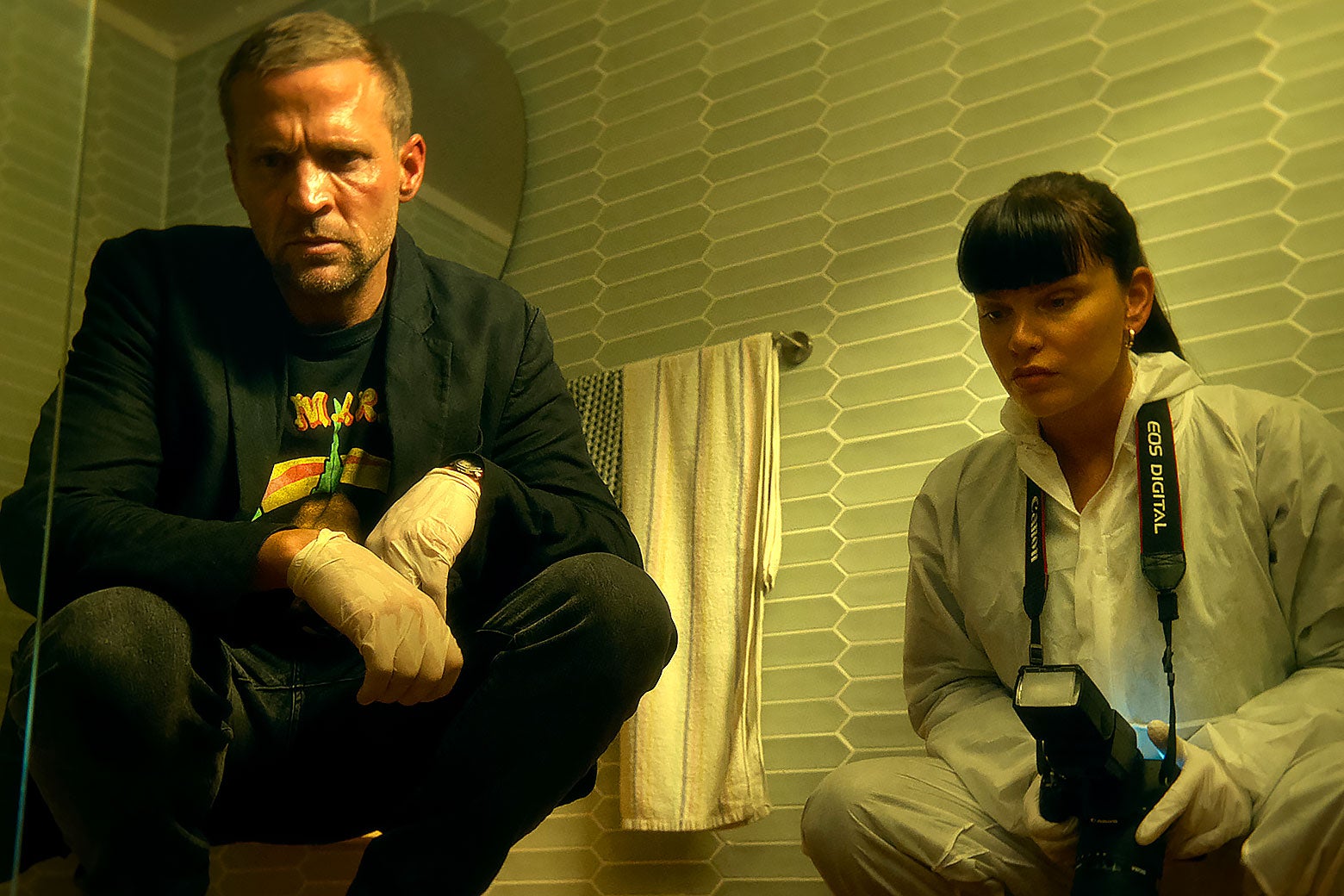
But none of these can compare to Kinnaman’s Waaler, a smirking, sharply dressed villain so polymorphously deviant that he’s practically a walking copy of Krafft-Ebing’s Psychopathia Sexualis. Waaler sexually harasses the young forensic investigator with the Bettie Page bangs, pulling on her long, shiny ponytail, insinuating that she “likes that,” and threatening to kill her if she tells anyone about it. He belongs to some cultlike group of indeterminate intentions that meets wearing black animal masks and cloaks. He sneaks into Rakel’s house at night to stare at her and her kid while they sleep. He has an encounter with a sweet street hustler that culminates in nauseating violence. He sometimes seems to have the hots for Harry, whom he also hates, and in one particularly gratuitous scene, Waaler dances in his underwear before a wall-length mirror, rubbing up against his own reflection.
Waaler and Harry are far from the only fit male characters to prance around Detective Hole in their tighty-whities for no evident reason. The series has an ambient, though poisoned, homoerotic undertone that’s difficult to parse. The naked women in the show are all dead and mutilated, a frequent phenomenon in Nesbø’s books, which often feature baroque torments inflicted on female victims, described in loving detail.
That’s not uncommon in serial-killer thrillers as a rule. The genre hovers between horror and crime, between the supernatural and what could actually happen, powered by a dark ambivalence about sex. But its connection to reality is tenuous at best. Serial killers, unlike vampires, exist (even if one Nesbø thriller does feature a murderer with false metal teeth who uses them to drink blood), but most real-life serial killers don’t actually resemble the brilliant fiends of fiction, with their elaborate codes and rituals. The terrifying paraphernalia of the serial-killer thriller turns a rare but very human criminal into a semi-mythical monster. Following the heyday of the genre in the 1980s and ’90s, writers were obliged to invent even weirder, more elaborate homicides in order to continue to shock their readers. The master of the serial-killer thriller, Thomas Harris, is an evident influence on Nesbø. But Harris long ago realized that the only path forward for the genre was camp. His Hannibal Lecter novels and other thrillers became deliriously over-the-top, a form of self-parody that opened the way to taking the serial-killer motif in eccentric and interesting new directions, as the Hannibal TV series did.
Nesbø has never seemed to get this, though his gazillions of fans apparently don’t mind his clichés, the untrammeled sadism, and whatever is going on with the psychosexuality of his work. Granted, I did find myself laughing out loud at a couple of points during the finale of Detective Hole, but that was more at the show than with it, so rushed and preposterous is its denouement. Norway, I think, is off the hook—the perverts are all on Nesbø.