Of the many standout scenes from last year’s best movies, perhaps the most striking is the showstopping, several-minute-long, uninterrupted musical set piece in Sinners. You know the one: the sequence of Miles Caton as preacher’s boy Sammie singing the Oscar-nominated song “I Lied to You” in the Smokestack twins’ juke joint, while a single Steadicam tracking shot shows the past, present, and future of culture and music coming together in the party of the century. The segment is not only narratively important, marking the transition from Sinners’ first half as a Southern slice-of-life drama to its second half, where it becomes a campy vampire flick full of deeper metaphors, but also one of the most memorable parts of any film in recent memory. It’s the type of scene that makes viewers practically levitate out of their seats. The first time I saw it, it nearly brought me to tears. I was certain that this moment was not replicable in any other form.
Well, I’m happy to report that the 98th Academy Awards proved me wrong on Sunday evening.
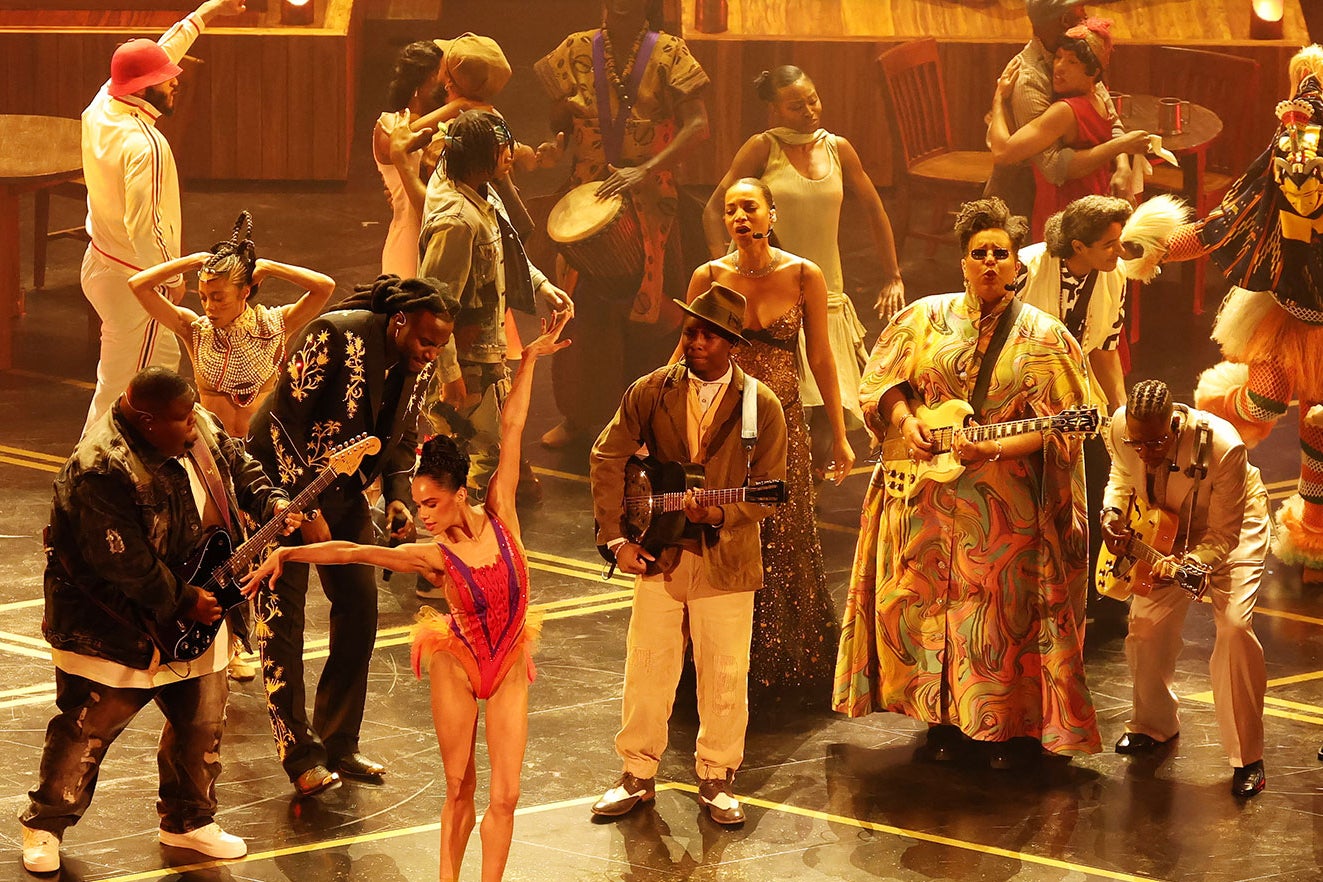
When the Oscars announced that “I Lied to You” would be one of the night’s two performances—with KPop Demon Hunters’ “Golden,” another contender for Best Original Song, being the other—everyone suspected that it would be a hard feat to pull off. How were they planning to put all of that vibrant life and movement into a song that, in the film, is so well matched with its visual component? The answer, as it turns out, was simple: by painstakingly re-creating the scene itself, almost beat by beat, on stage, live in front of the Oscars audience.
The performance began with Raphael Saadiq, a legend in Black music and one of the song’s writers, who kicked things off solo, singing with his acoustic guitar. Then the camera panned to Caton, singing and playing on his guitar while leaning against a piano with fellow Sinners stars Jayme Lawson and Li Jun Li dancing beside him. As Caton sang, the camera panned around and beyond him, showing that the set was a re-creation of the film’s juke joint, complete with dancers grinding on each other like they do in the movie. The camera weaved through the mass of moving bodies that looked like they had just stepped off the Sinners set, complete with copious amounts of sweat. Buddy Guy, the 89-year-old legendary blues musician who is present both in the film and on its soundtrack, appeared stage left while other musical guests joined Caton. Country singer Shaboozey, singer and guitarist Brittany Howard, blues guitarists Eric Gales and Christone “Kingfish” Ingram, and blues singer Bobby Rush also made appearances.
In the film, this point, when the music shifts to incorporate a hip-hop beat, is when the juke joint becomes a spiritual place where the boundaries between timelines cease to exist. The bodies grooving to the blues music are joined by representations of their past and present. The sonic shift is spearheaded in the movie by a DJ. On Sunday night, we saw the same on stage, with a DJ that some social media users are identifying as popular emcee D-Nice turning the blues song up with the iconic trap beat that underlines the second half of the tune. This was when the myriad types of dancing that appear in Sinners time-bending scene also appeared on stage: traditional African dancers, hip-hop dancers, breakdancers, traditional Chinese dancers, and trailblazing Black ballet dancer Misty Copeland.
Shockingly, the stage production managed to really imbue the energy and the technical feat of the scene into the live version, using impressive camerawork and intricate blocking of the performers. The performance also threw in many winks to the movie, including a moment when the camera followed Caton as he walked down the stage’s steps to see the actors who play the white vampires of the film—Jack O’Connell, Lola Kirke, and Peter Dreimanis—wearing fangs and asking to be let up on stage. The action then returned to the stage, where musician Alice Smith joined all of the performers to help belt out the finale to the song.
The performance received a standing ovation from the audience at the Dolby Theatre. That reaction was rightfully earned: It was nothing less than an achievement to take one of the most complex and impressive scenes of a movie and re-create it, in both technicality and spirit, on stage. Not since Ryan Gosling’s hilarious performance of Barbie’s “I’m Just Ken” has an Oscars musical performance nailed both aspects with such aplomb. This is particularly meaningful given the backdrop of this year’s awards season, which has been riddled with controversies and debates—many of them racialized. Whether or not “I Lied to You” ultimately takes home the golden statue on Sunday night, it managed something more everlasting: being one of the coolest, Blackest moments to ever occur on the Oscars stage. And that is anything but a lie.