Sign up for the Slatest to get the most insightful analysis, criticism, and advice out there, delivered to your inbox daily.
We think of chickens as flightless birds, but they’re not. In fact, it’s common for them to travel modest distances via stints of explosive flapping. This phenomenon, known as “burst flight,” is sort of beautiful to watch: Chickens leap upward at a sharp angle, then start pumping with manic abandon. As their wings cut tight figure eights, they shoot forward and drop into a glide. They never get very far, but there’s something existentially profound in the effort. Chickens fly as if they’re trying to escape the inevitable.
For these bulky birds, flying is a tool mainly for roosting and escaping predators. Their burst flights are expressions of anaerobic exertion—not entirely dissimilar to a human running at full sprint. It’s a finite feat, and it wears them out.
Much of this is true of rubber chickens too. To get airborne, they first need a hefty shot of kinetic force. From there, it’s a question of how far this force can take them in defiance of gravity’s pull. Things like skin texture (latex is best), length (shorter is better), and weight all influence the trajectory. Depending on the brand and specifications, a rubber chicken might twirl like a football in flight, or strafe on the breeze, or let out a long, braying whine. Like a living chicken, it tends to land gracelessly.
The first rubber chicken I ever threw didn’t go very far. Part of this was simple physics: The wind was against me, and the projectile was large and light. I’d purchased it without considering optimal flight dimensions. The other factors were physical. The vessel propelling my rubber chicken into the air was the right arm of a 38-year-old male body. I am 5-foot-10 and weigh approximately 165 pounds. Although I possess average strength and slightly above-average footspeed, I am not—nor have I ever been—elite at any form of sport. Now, as I approach 40, I’m becoming familiar with the slow betrayals of aging. Each morning, my heels and lower back ache for reasons that elude me. Gravity tugs at my love handles and salt-stubbled jowls, and I suspect that I’m slowly becoming lactose intolerant. Inexplicably, I’m still very ticklish.
If you’d like the literal reason I started throwing rubber chickens, it’s because I wanted to break the Guinness World Record for the longest throw of a rubber chicken. If you want the more honest reason, it’s because I recently sank into a midlife crisis.
One morning last spring, I woke up unemployed and profoundly depressed, questioning whether the time and care I’d poured into my career had been worth anything at all. It didn’t feel like it—it felt as if I’d fallen asleep and woken up 10 years behind many of my smarter and more charismatic peers. My children, meanwhile, were no longer doughy cherubs, reliant on my strength and cereal-reaching capabilities. They had taken to stomping around the house, slamming doors and making Spotify playlists. Recently, my son handed me a fatherhood report card he’d drawn with a “Z-minus” grade on it.
Because it is in my nature, I began speaking to experts, who assured me that a lot of this is normal. Normal to experience angst and uncertainty during this time of life; normal to have doubts and take stock. But something about my scenario seemed dire. My brain chemicals, the little bastards that they are, had edited together a nonstop blooper reel of my failures. I needed a win.
The rubber chicken idea came one summer evening while my wife clipped the kids’ toenails. As they watched Guinness highlights on YouTube, I saw the current record holder, a Turkish security guard named Osman Gürcü, loft his own toy chicken a distance of 114 feet, 9 inches across a soccer pitch. Gürcü had close-cropped hair and wore a red tank top. He seemed roughly as athletic as I was, and a little older. His throwing technique involved a sort of javelin-style stutter step, followed by a primal scream.
I chuckled at first, marveling at the inanity. Then I remembered the calamitous nature of my own affairs. Who was I to judge? Wasn’t there actually something dignified about Going For It, whatever it might be? In an era when unserious men seem to have been handed many of our country’s most serious tasks, what harm could come of a humble attempt to reverse the dynamic? And why not a rubber chicken, America’s trusty totem of self-parody? It’s not as if I could beat the Earth’s best powerlifters, breath-holders, or yo-yo artists. Desperate times called for farcical measures.
My body ignited with a hot resolve. I had to break this record. I had to make a mark—to prove something. The exact contours of which could be sorted out later. And I had to do it soon.
But first I would need to prepare.
“So would this be some sort of discus motion, then?”
It was late September, and I had finally reached Adrien Mellion, the proprietor of a Manteca, California–based track and field training outfit called ThrowsLab. He was the first (and only) throwing coach to respond to my inquiries, and I could hear his bewilderment as we spoke over the phone. He had ignored my previous emails, believing them to be a joke or scam. But now, perhaps picking up on the anxious tremolo in my voice, he agreed to a one-on-one session.
We met two weeks later at an athletic field in Modesto, California, an hour and a half from my home in Oakland. Mellion is sturdily built, with a gravelly laugh and a Clorox-white smile. The thing all the great ones have, he explained, is an obsession with consistency: Throwing is all about repetition and small adjustments that might earn you a tiny edge here or there. “If you had a 1-inch PR, that might get you to states,” he told me.
“You can’t get too high, you can’t get too low,” he continued. “You’re gonna have bad throws. That’s why we throw so much in practice. You just try to balance it out—but it’s never a finished product.”
Mellion waited for his small class of throwers to wrap up, then took me to a nearby discus field. He instructed me to grasp my rubber chicken by the neck and plant my back foot. I needed to bend my knee and pivot through the big toe, winding up for a sort of hip-powered whipping motion. The goal was to release my chicken at a 45-degree angle as my right arm flew around. Just as he’d predicted initially, it was a sort of bastardized discus routine. I wound up again and again, imagining myself delivering superhero-strength blows to some monstrous villain. Mellion watched closely, occasionally adjusting my posture or reminding me to breathe.
It was surprising to witness the seriousness he brought to my task. He was focused on the small details, undaunted by the absurdity. It felt as if I had brought him a puzzle he couldn’t resist trying to solve. After about half an hour of watching me throw, Mellion took out his phone and tapped open its measurement app. He reported the distance: roughly 75 feet—well shy of Gürcü’s record, but honestly a lot better than I’d expected.
“I think you can break this record,” he said, smiling.
He wasn’t alone. A few weeks later, I found myself face-to-face, via Google Meet, with Gürcü himself. It was late at night in Turkey, but he was full of energy—thrilled that someone in the U.S. had taken an interest in his record setting. He had drunk a cup of coffee after getting off work to prepare.
We began with a review of the Guinness ground rules. The rubber chicken could be any size, make, and weight as long as it was “commercially available.” The toy could not be modified in any way, and I had to grip its body, not its neck or head, during my toss. There would be no official Guinness representative at the site of my attempt in Oakland. Instead, I had to invite two witnesses to film the throw, as well as a professional surveyor to measure the distance and slope of the terrain. Then I needed to upload that evidence, along with a cover letter, to the Guinness website.
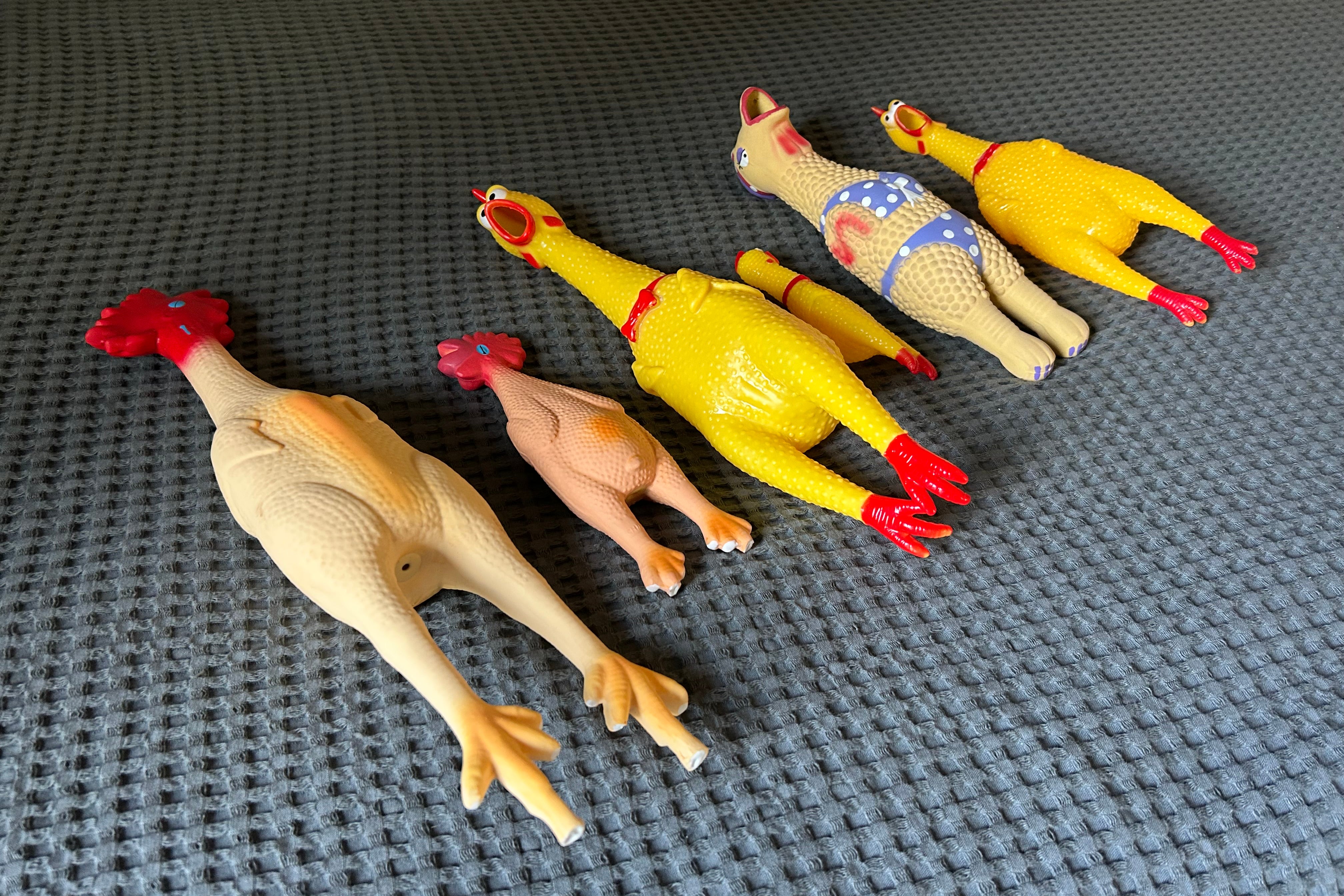
I had been nervous to tell Gürcü I was coming for his record. But when I did, he was elated and eager to talk shop. It turns out that as with traditional bird flight, the ideal rubber chicken throw is all about physical parameters. To maximize my distance, Gürcü explained, I would need a chicken whose weight exceeded 150 grams and whose height was short enough that it didn’t catch too much drag in midair. He held up his winning chicken, a 13-inch latex bird with a crimson head and cartoonish blue eyes. He’d found it at a local pet shop.
“The proper technique, the proper practice and regimen is the key,” Gürcü said. To accumulate world records like the 19 he has (including farthest axe throw, longest cornhole backwards shot, and farthest dart bull’s-eye hit), you have to find niches that few have explored and few would want to. You also have to distinguish between doing things the normal way and doing them the Guinness way.
Take the longest-ever table tennis serve, a feat Gürcü achieved last February. “The game itself and what I’m doing is completely separate,” he told me. You throw out the conventional rules of doing something well and instead focus on doing one aspect of it to the max. In the absence of God-given strength or speed, you must master the minute details nobody else has ever bothered to perfect. Then you must navigate Guinness’ baroque application process.
As we finished our conversation, Gürcü urged me to stay in touch with questions about technique or chicken dimensions. He followed up with a barrage of direct messages on Instagram: words of advice, links to chickens he thought might be up to the task. It was a strange feeling, being lifted up by him and coach Mellion in this way. Odd to have two strangers in my corner, invested in my trivial quest for dubious renown. It was also sort of contagious.
“This is when I actually realize the importance and the magic of Guinness—the value it brings,” Gürcü had told me before we said goodbye. “Through Guinness and the contest, I have something to show my kids in the future.”
It’s common—fashionable even—for each generation to diagnose its conditions as uniquely, ahistorically dire. But could there finally be something to that sentiment in 2025, with the youngest of our cohort about to turn 30 and the oldest around 44?
Like every generation that has come before us, we’re inking an unsteady truce with our own mortality while also wondering what the fuck is going on. We’re trying to decipher how, exactly, to enter our second acts with dignity. There’s the practical stuff—dialing our pickup basketball games down from thrice weekly to once; drinking more water; appreciating the alarming distinction between falling and having a fall.
But then there’s also the world to grapple with. A recent survey about millennial midlife crises found that more than half of us don’t think we’ve succeeded in adulthood. Thirty-eight percent of us don’t feel mentally stable, and a staggering 87 percent don’t believe that older generations understand the challenges we’re up against. More than other age groups captured in another recent study, we’re burning through our paid time off to simply lie down and sleep. Meanwhile, as Trump-era cronyism runs unchecked, the country’s trust in government is nearing an all-time low. A recent Wall Street Journal–NORC survey found that around 80 percent of Americans think that life will be worse for the next generation. Unlike middle-aged adults of yore, we wake up each morning to phones that barf out bleak factoids about climate change, political violence, racism, and automation. Our economy, meanwhile, is little more than a plaything for man-child billionaires who have finally grown too lazy to disguise their misdeeds. Staggering wealth inequality no longer feels like an outrage; it has become the cloud cover of our daily lives. Forget affording the ill-advised red Mazda Miata. We can’t afford even the divorce.
We bemoan our “pointless” futures on Reddit. In New York magazine, we grapple with what it feels like to suddenly be “an old young person.” In some cases, we fantasize about acting out. In her 2024 novel All Fours, Miranda July’s 45-year-old narrator lies to her husband about taking a trip to New York City, only to hole up in a hotel room she converts into a plush sex den. Horny and adrift, she follows her desires like a watering stick, hoping they point toward fulfillment.
“I understood that death was coming and that all of my current preoccupations were kind of naïve,” July’s narrator says. “I still operated as if I could win somehow. Not the vast and total winning I had hoped for in the previous decades, but a last chance to get it together before winter came, my final season.”
Even experts agree. “A lot of the things that go on in midlife really haven’t changed,” said Margie Lachman, a psychology professor at Brandeis University who has studied the concept for 30 years and will soon publish a book on it. “What’s changed, to a certain extent, is the external forces, or the environment, or things that are affecting people’s ability to accomplish the goals that they had set for midlife.”
In one study, Lachman and her co-authors pointed to a constellation of “unprecedented societal challenges”—a shrinking social safety net, a vulnerability to “labor market volatility”—to argue that our generation needs a sort of psycho-emotional bailout. “If the well-being of those in midlife is threatened rather than protected, the repercussions could reverberate throughout families and society.”
Yet she’s also quick to point out that the stereotypical trappings of a midlife crisis—sports cars, affairs, leather jackets—are mostly Hollywood hogwash. In fact, midlife can present a happy array of opportunities: You’re old enough to have mastered a vocation or hobby, yet not so old that your skills have deteriorated. As proof of this, Lachman, in studying the output of inventors, has found that their most productive periods occurred in their late 30s and early 40s.
As Lachman spoke, I wondered if my chicken-throwing record might count in the same way. After all, wasn’t I deploying an array of skills—physical, intellectual, administrative—that few others would have the persistence to meld in such a way? And when all was said and done, wouldn’t I enjoy telling my children, my friends, that I was the world leader in a lone, esoteric feat? Was I not at the peak of my powers?
“Don’t think you’re running out of time,” Lachman told me. “Realize you have a lot of time left. You have half a life left!” In the immediate term, though, I had just a few weeks to break this record.
Just as there is an art to throwing rubber chickens, so too is there an art to practicing the act without detection. In the lead-up to my Guinness attempt, I had taken to training in a local park’s tree-lined corner. The timing of these sessions was critical: I needed to get my reps in before elementary-age children arrived at the after-school program nearby and started asking tough questions: Who are you? Or: Why are you throwing rubber chickens? Or: Do you really think this will cure your nagging sense of abstract forfeit? In times of doubt, I called to mind advice from Cincinnati Bengals quarterback Joe Burrow, who years ago warned the next generation of athletes against turning their workouts into TikTok fodder. “Work in silence,” he advised. “Don’t show everybody what you’re doing.”
Thus, I settled into a weekly routine: I would walk to this park with a peep of chickens tucked into a canvas New Yorker bag. (I had to be careful not to halt or pivot abruptly, lest the sack emit a chorus of mortifying squawks.) I would warm up with a few dozen tennis ball tosses against a cement wall, then it was off to the field to chuck my birds. Because of the Guinness rules forbidding a participant from gripping the chicken by the head or neck, I had tweaked my approach to more closely resemble a javelin toss.
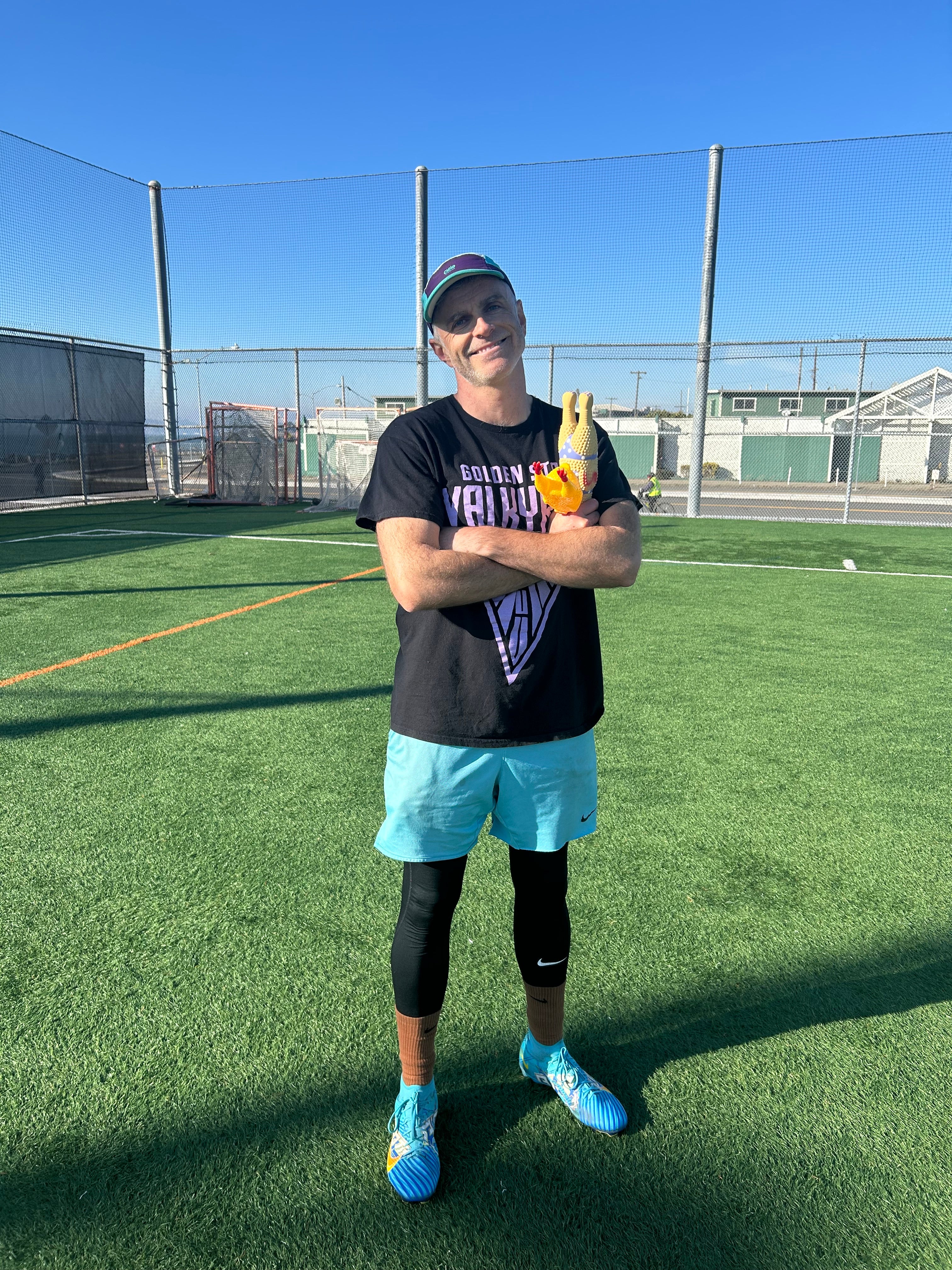
The first time I broke the record, unofficially and by myself, was on a breezy November day. The chicken I was throwing was not the same model Gürcü had used. But it was store-bought and met several essential criteria: not too long, as heavy as possible. My best throw that day—around 116 feet—was undoubtedly wind-assisted. But it felt monumental anyway.
As I was packing up to leave the park, I heard a child’s voice coming from the school building nearby. He and his friend had been watching me the whole time, despite my efforts at subterfuge.
“You can do it!” he shouted through an open classroom window.
“Six-seeeeveeeennnn!” shouted his friend.
I smiled and waved.
For all volant birds, takeoff is its own art, complete with trade-offs and limitations. Consider pigeons. Thanks to a combination of body composition and instinct, they can fire themselves effortlessly into the air an instant before getting flattened by your boot or car tire. Herons, on the other hand, are lankier and heavier. They need a lot of runway. That’s why you might see one preparing its wings when a predator is still creeping around nearly 200 yards away. They’re skittish, hardwired with an understanding of their own limitations.
I too was mulling limitations on the afternoon of my official attempt. It was a bright and chilly December day, and I had controlled what variables I could—practiced as much as felt sensible, tested nearly a dozen chickens, identified an athletic field by the San Francisco Bay that was most likely to create favorable wind conditions. Dimensions-wise, the rubber chicken I’d settled on was a near match to the one Gürcü had recommended, though there were key sartorial differences. Specifically, my $6.83 Outward Hound Squawkers squeaky latex dog toy was named Henrietta and came clad in a purple polka-dot bikini and swim cap. This outfit, I had to admit, felt appropriate.
I had arranged for a team of surveyors to meet me at the field, per Guinness rules. In addition to measuring each throw’s distance, they had to ensure that the surface was completely level. For all Guinness throwing records, the average gradient under your attempt cannot exceed 1:1000. If it does, you must throw uphill. By sheer chance, the surveyors I’d found—a father–daughter duo—had both been competitive throwers themselves. They were delighted to be taking part in this attempt and, like coach Mellion, went about their duties with a heads-down seriousness that felt more than a little misaligned with the task.
My warmup throws, aided by a trusty onshore breeze, were promising. I watched with satisfaction as Henrietta sailed past the 100-foot mark once, twice. There were other sources of lift too. As I wound up, I thought of Gürcü, who had wished me luck, via Instagram DM, earlier in the day; of my wife and her colleague Nick, who had come to record my attempts for the Guinness application. I thought of my friends’ excitement when they had learned about my project.
But in the end, gravity won.
As I was warming up, the surveyors approached me with unfortunate news: The field I’d selected had an almost imperceptible slant that precluded me from throwing in the same direction as the wind. I would instead have to throw across the wind, aiming my chickens far to the right and watching them slice down into our agreed-upon target area. Not ideal, especially since records this niche are won on the margins, through clever manipulations of one’s conditions. I’d found the right chicken, the right mechanics. But perhaps the wrong venue.
I threw till my arm ached and the wind chapped my lips. My best attempt was about 103 feet—roughly 12 short of Gürcü’s record. I called it after about an hour. As the surveyors packed up, they refused to let me pay their customary $225 hourly fee. Instead, they instructed me to get in touch again when I had found a flat field and a good tail wind. They’d be back to help.
I had failed, technically. So why did I feel like less of a failure than I had in months? Perhaps because focusing on the project had helped me siphon brainpower away from my turbocharged self-doubt cortex. Perhaps because it was enough to know that friends, family, and unidentified schoolchildren were rooting for me, no matter how ridiculous the task at hand. Or perhaps Lachman was right: I hadn’t given the opportunities of midlife the consideration they deserved.
Whatever it was, I drove away from the field feeling lifted, lighter. Maybe I’d considered only limitations and forgotten that my second act had yet to be written. Maybe I was simply at my burst flight’s apex, with plenty of flapping to go before gravity finally pulled me down.