Sign up for the Slatest to get the most insightful analysis, criticism, and advice out there, delivered to your inbox daily.
Gas prices are spiraling, and it seems more American soldiers are redeployed to the Middle East almost every day. But at the Conservative Political Action Conference, the annual conservative confab held this year in suburban Dallas, the ongoing conflict with Iran seemed relatively remote. At the event, which has become a sectarian gathering for fervent Trumpists in recent years, there was little dissension over the president’s decision to mount an ongoing air campaign against the Iranian regime.
The conflict was not front and center at the conference, which featured panels with titles like “Cigars, Steaks, and Ivermectin: A MAHA Survival Guide” and “Get Schooled: Don’t Let Woke Marxists Raise Your Children.” But even where it did get mentioned onstage, the deck was stacked against a fulsome geopolitical debate.
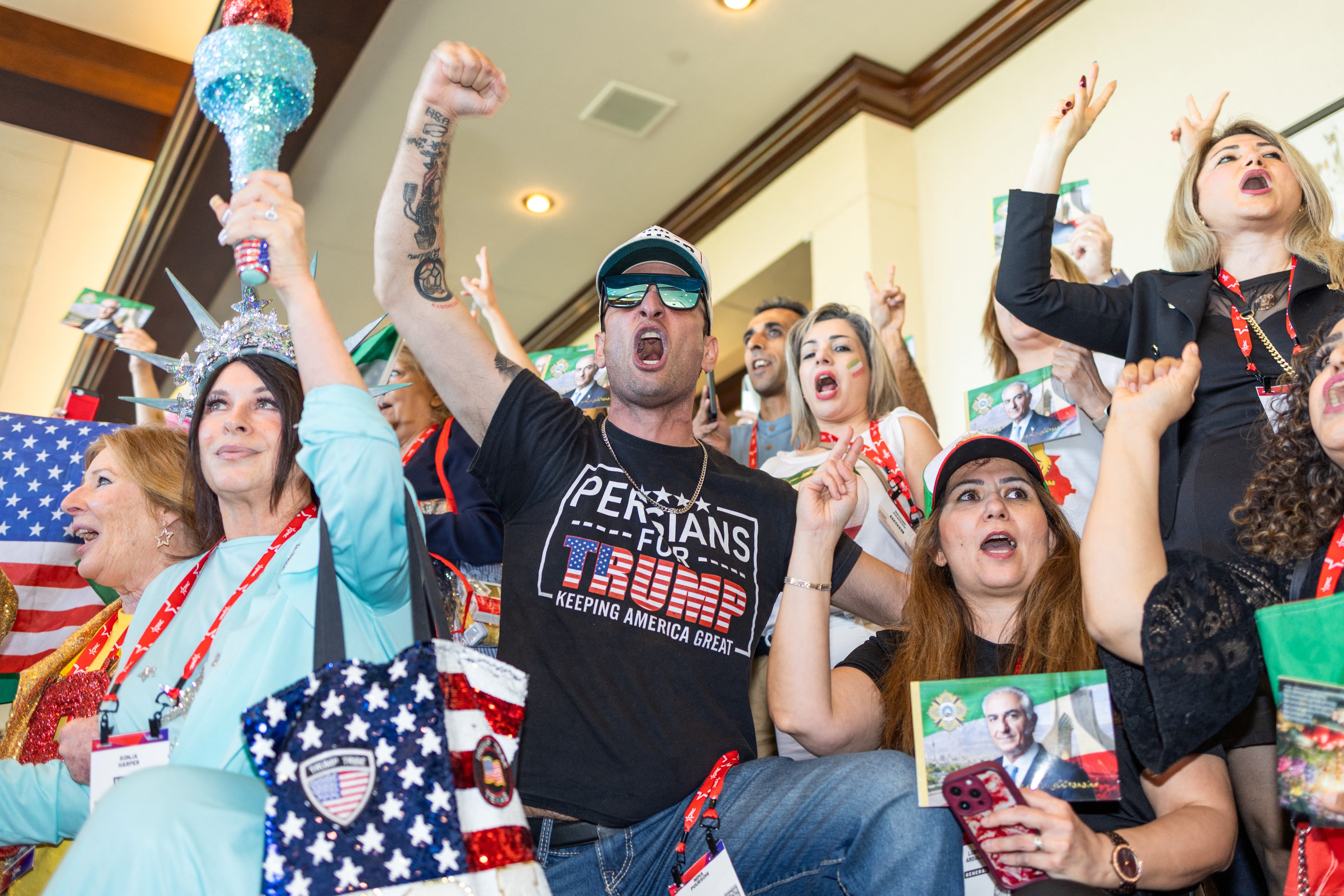
Reza Pahlavi, the eldest son of the last shah of Iran and pretender to the throne, was a scheduled speaker, and the event was packed with Iranian monarchists. At times, the Lion and Sun flag—the national flag of Iran before the 1979 Islamic Revolution—seemed almost as common as the Stars and Stripes. Occasionally, outside the halls in the spaces where attendees milled about during more tedious panels, fans would lead cheers of “King Reza Pahlavi” and “Regime Change for Iran.”
Onstage, there was a panel with “victims of the ayatollah,” who shared stories about how they had been blinded by the regime. Mercedes Schlapp, whose husband, Matt, leads the group that puts on the conference, told the crowd an almost tailor-made horror story about how the Iranian regime murdered a young boy because he had a picture of Jesus Christ in his room.
Offstage, there was solid support for President Donald Trump’s decision from a gathering of some of his strongest loyalists—after all, it was a crowd in which you were as likely to find someone who stormed the Capitol on Jan. 6 as someone who had cast their primary ballot for Ron DeSantis.
Needless to say, if you backed Trump’s efforts to overturn the 2020 election, you weren’t likely to have misgivings about him overthrowing the Iranian regime. Mike Lindell, the mustached MyPillow mogul, rhapsodized about Trump’s “God-given gift.” “He knows what it’ll manifest to … you’re gonna look back 20 years from now and everyone will say every move he made was genius,” he said.
Enrique Tarrio, the Proud Boy sentenced to 22 years in jail for seditious conspiracy for his efforts to overturn the 2020 election, told Slate he was “very supportive of the president’s strikes in Iran.” Tarrio, who received a pardon from Trump in 2025, caveated, “Do I want boots on the ground? No, but that’s not my lane, Iran’s not my lane. Will it make me lose support for the president? Absolutely not.”
Brandon Fellows, who stormed the Capitol on Jan. 6, had traveled to the conference to sell imitation Immigration and Customs Enforcement uniforms as costumes. (The blue faux uniforms were a great gift for those who both supported Trump’s immigration policies and reveled in the slightly transgressive nature of pretending to be ICE agents.) Brandishing a sombrero, Fellows also expressed his confidence in the president. “Trump has a tendency to surprise us and turn things around,” he said. “What I will say is that he needs to wrap it up, whether it’s victory or pull out before probably about three to five months, before the midterms are over. But if he can control the straits and we can lower oil prices, that could be an ultimate win.” Fellows was sentenced to 42 months in prison for his actions before he was pardoned by Trump.
Even those attending whose support for Trump had not led them to face federal investigations were still confident in his foreign policy as part of a broader strategic vision. MVTSU, an influencer in a tank top that pictured Trump looming above the White House with the caption “Daddy’s home,” thought “in a grand scheme of things … what we’re doing is isolating China from more of its oil and stuff like that. That not only benefits us in the long run, but also we’re taking out a great antagonistic power in the Middle East.”
This was echoed by Paul Sorensen, a railway worker from Illinois who thought that this was part of “a master plan.” In Sorensen’s view, “I don’t think it’s necessarily Iran. I think it’s about oil and I think it’s about choking up oil from China.” He did concede that there were skeptics, like his son-in-law, who had accompanied him to CPAC. “I think a lot of people are like, What the hell? He’s supposed to be Make America Great? Why the hell is he in Iran?,” said Sorenson. “I just think there’s a much bigger picture.”
The only explicit note of dissent came from former Florida Rep. Matt Gaetz, who was a fervent noninterventionist while in Congress and has since become a vociferous critic of Israel in his perch on hard-right One America News. Yet even in his speech on Thursday, Gaetz only explicitly criticized the potential deployment of troops on the ground in the Middle East rather than the ongoing air campaign. “A ground invasion of Iran will make our country poorer and less safe, higher gas prices, higher food prices and I’m not sure we would not end up killing more terrorists than we would create,” he said. Gaetz received a rebuttal from the stage shortly after, when hawkish conservative commentator Josh Hammer described him as part of the “retard right,” a group in which he also lumped figures like Tucker Carlson and Megyn Kelly. Hammer’s line was ample fuel for the intra-conservative foreign policy debates waged constantly between influencers and pundits on podcasts and X.
But that’s a debate that wasn’t taking place at CPAC. After all, polling has shown Republican voters overwhelmingly approve of military action against Iran and think the campaign has been successful so far. They may have some nagging concerns and some lingering doubts. But Donald Trump thinks this is a good idea. The debate may continue far away from this cavernous conference center in Texas, but among his political base, the consensus is clear.