Sign up for the Slatest to get the most insightful analysis, criticism, and advice out there, delivered to your inbox daily.
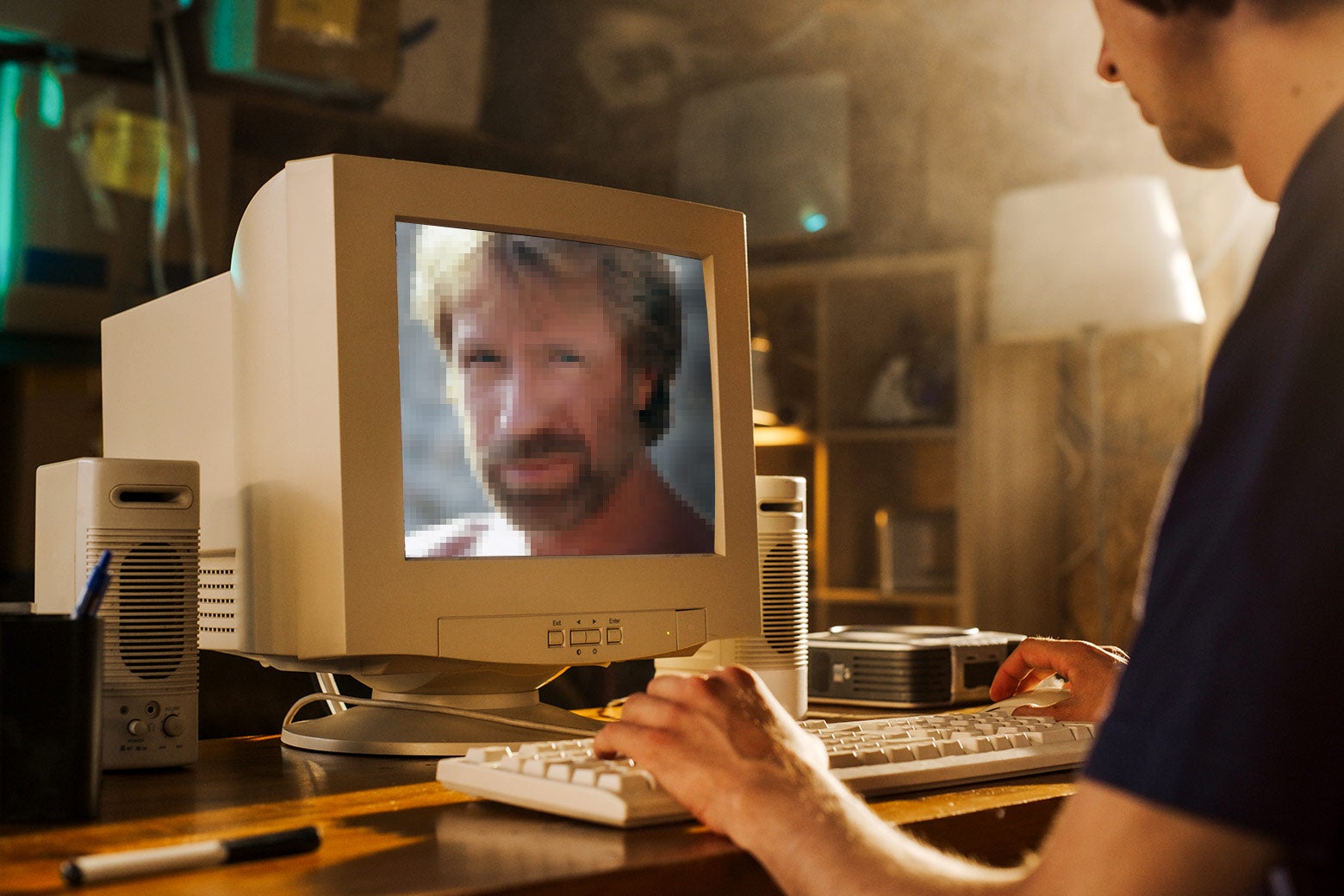
Any proper tribute to Chuck Norris—the veteran airman, martial artist, actor, and pro-Trump writer who died Thursday at the age of 86—must keep two seemingly contradictory facts in mind. For one, he was undoubtedly an American icon, a rugged-individualist fighter on- and off-screen who symbolized the international cultural influences, TV-star ubiquity, and B-movie campiness that defined a potent form of sweaty masculinity in the late 20th century. This was a man who defeated Joe Lewis in the ring, was mentored by Steve McQueen, co-starred with Bruce Lee in The Way of the Dragon, anchored Walker, Texas Ranger on CBS throughout the ’90s, and wrote plenty of well-read, outrageous columns across the right-wing mediasphere. And yet, for all his decades of celebrity, Norris will likely be best remembered as a pioneering internet meme.
You know exactly what I’m talking about. Across the backends of the internet, cheeky characterizations of Norris-as-god still abound: Chuck Norris can believe it’s not butter, Chuck Norris doesn’t dodge bullets—they dodge him, Chuck Norris can slam a revolving door. The archives of websites like ChuckNorrisFacts still list out thousands of these quips, every single entry ranked and rated over the years by enthusiastic visitors—many of whom would readily admit they’ve never seen a single show or movie starring Norris, or read any of his books. (Unless it happened to be The Official Chuck Norris Fact Book, a 2009 volume compiled and endorsed by the man himself.)
Even though these “Chuck Norris Facts” came to prominence on the mid-2000s internet, the actor-fighter’s memeification really began on TV, thanks in large part to Conan O’Brien.* On his Late Night franchise, O’Brien immortalized the misadventures of Norris’ titular protagonist through a recurring bit known as “The Walker, Texas Ranger Lever,” which showcased bizarre clips from the show to the delight and bafflement of his NBC audience. Perhaps most infamous: the 1997 segment where a child portrayed by a pre–Sixth Sense Haley Joel Osment reveals to another character that “Walker told me I have AIDS.”
“Walker Lever”–style jokes were thus primed for further takeoff on the burgeoning Web 2.0 circuit, as Walker enjoyed syndicated reruns and social media really began taking off. By 2005, shitposters on the influential Something Awful forums had begun riffing on Vin Diesel’s flashy stunts in the Fast & Furious movies—but soon found they could make much more hay out of ascribing those outlandish deeds to Chuck Norris, whose roundhouse kicks and rippling muscles still lingered in the cultural psyche.
Lest we forget, the Iraq War–era jingoism that inflected American pop culture at the time was also a fundamental motif of the 2000s internet. Though many of those “Chuck Norris Facts” were facetious and mocking, there were just as many that served as unironic celebrations of the man. The Walker image of a surly, good-hearted, competent Lone Star cop especially resonated in a moment when a fellow Texan, George W. Bush, was leading our troops into a (seemingly) righteous war on terror, fueled by an overwhelming spirit of America as international ass-kicker. Chuck Norris does not fear death. Death fears Chuck Norris.
The patriotic fervor that made Chuck Norris an internet legend fell flat as America entered a much more doubtful age: the undeniable failures of our Middle East ventures, the dire fallout from the Great Recession, the racist backlash to our first Black president. Norris himself became far less amusing as the conservative movement radicalized, parroting much of the same homophobia, Islamophobia, and anti-Black racism (especially via “birther” conspiracy theories) that his ideological compatriots expressed on the regular. And he explicitly associated his memes with his politics, as 2008 GOP presidential candidate Mike Huckabee sat next to Norris and read out some of his “facts” in a campaign ad.
Norris’ cultural presence also waned as he aged. His last major film role came in 2012 with The Expendables 2, where his appearance functioned largely as a wink to the internet persona that eclipsed him. And he only doubled down on Republican extremism as Donald Trump ushered in the MAGA age. Some of his own fans even came to turn on him as he took an ill-advised sponsorship from Glock in 2019, right in the midst of an epidemic of mass school shootings that, tragically, has not abated.
His vanishing cultural presence also exposed another inconvenient fact—that he was hardly as godly as the memes made him out to be. You will not find most of his movies or shows on any best-of lists. That’s not because he was a right-winger; Clint Eastwood, still as reactionary as ever, retains the respect of his more liberal peers for his consistently high-quality output. Norris never had that to fall back on. But he’ll always have the memes, which, although premised on his past work, actually catapulted his name to a level of immortality that his filmography alone never could.
Correction, March 21, 2026: This piece originally misstated that Conan O’Brien’s “Walker Lever” began in the 1990s. The segment first aired in the 2000s.