Sign up for the Slatest to get the most insightful analysis, criticism, and advice out there, delivered to your inbox daily.
Instagram photos of white boys drinking Tsingtao beer and playing mahjong. John Legend dressed in traditional Peking opera wear. Videos upon videos of Americans ditching ice water for hot water in the morning, boiling apples into tea, and saying that we have met them “at a very Chinese time” in their lives. “This is my first time being Chinese, I’m trying my best,” one wrote under a TikTok.
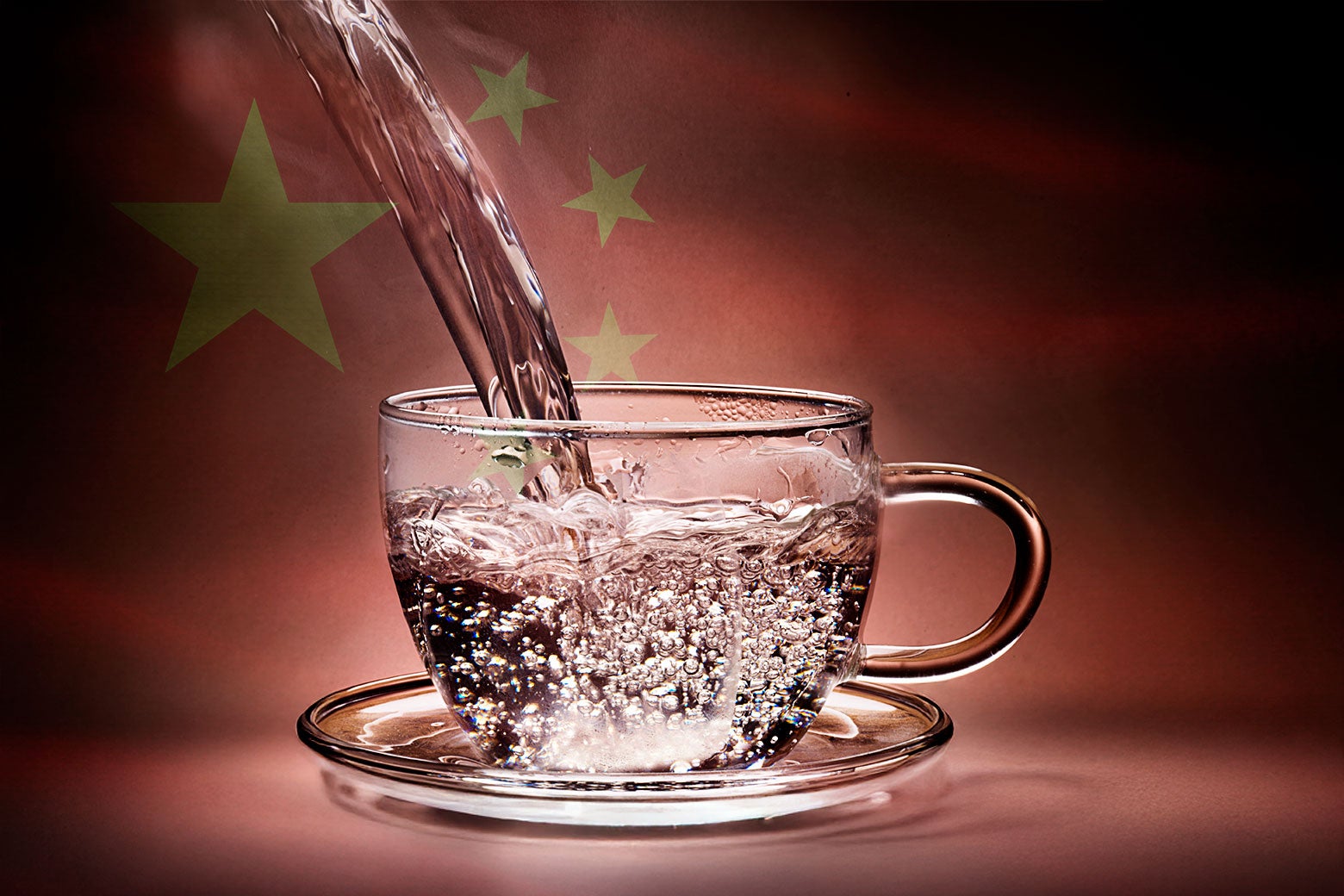
Over the past year, Chinamaxxing has overtaken social media. The trend is semi-satirical, with users eschewing American habits in favor of Chinese ones: adopting practices based on traditional Chinese medicine, wearing clothes inspired by traditional Chinese garments, and repeating, ad nauseam, the very Chinese quality of all of it. Chinese American content creators like Sherry, who goes by @sherryxiiruii on TikTok, have amassed millions of views for their recommendations on how to become a “Chinese baddie.”
The subtext of the joke is, of course, the shock value of an American choosing to shift their allegiances to China—the country long framed in American culture as its single greatest geopolitical rival. But the humor also depends on something much older and more familiar: the idea of Chinese people as dirty, unattractive, and conniving forever-foreigners. On the surface, what looks like harmless internet irony is actually the latest iteration of a long-running tradition in which China and Asian cultures at large are flattened to punch lines.
Chinamaxxing comes at an inauspicious time for the U.S., and especially younger generations. Young Americans are battling ballooning costs of living, an uncertain job market, and an economy that only seems to favor those older and richer than they are. Many of them grew up with the long-standing belief that the U.S. is more technologically advanced and abundant in resources than any other place on earth—only for that notion to be shattered in 60 seconds via a random Zhejiang resident’s “day in the life” vlog. For many of these jokes, being Chinese isn’t really the point—but rather shock value. It’s the same feeling that a petulant toddler has when throwing a tantrum toward its parents. You told us we couldn’t have a high-speed railroad and universal health care, and it turns out they have it across the street! I’m going to live at their house now!
New York–based comedian Dan Yang, whose video about the Chinamaxxing trend amassed over 300,000 views on Instagram, told Slate that he doesn’t necessarily see the joke as malicious, but rather one born out of sheer ignorance.
“I think most non-Chinese people have never actually talked to a Chinese person aside from maybe ordering Chinese food. Even non-Chinese people who are friends with Chinese people probably see a very Americanized version of them,” he said. “I feel like an NYU kid from Ohio sees Chinese people in Chinatown like a new type of Pokémon. I don’t think there’s any hate involved, just a weird surface-level wonder.”
What young Americans know about China has historically been limited. Given government censorship and the cultural divisions among tech platforms, Chinese and American social media users never really overlapped to see each others’ regular routines and memes. What sparked a change last year was the one-night ban of TikTok, when uproarious Americans protested the shutdown by swearing they’d learn Mandarin and signing up in droves for Chinese social media app RedNote instead. “TikTok refugees” were shocked to see that the average Chinese city’s infrastructure outpaced their own, there was an ecosystem of memes and slang that they also found funny, and they could scroll through an abundance of vlogs about walkable cities, affordable health care, and cost of living that they didn’t get in their own lives. “Bro china lives in the year 3500 meanwhile we live in 1984,” one user commented under a video about Chongqing, China.
Morgan Sung, a tech journalist and host of KQED’s Close All Tabs told me that for her, Chinamaxxing was a refreshing change from the tired tropes around Chinese culture. But it got old quickly. “The memeification of Chinese culture is still Orientalism, but it’s socially acceptable now because in a way, it’s seen as punching up,” she said. “Punching down isn’t as obvious when China has high-speed rail and your own country doesn’t.”
Part of this has a lot to do with the fact that just a few years ago, there was a sweeping reinforcement of the stereotype that Chinese people are perpetual foreigners who carry barbaric diseases. “The pandemic reinforced American notions of Chinese people as foreigners,” Sung said. “Now, even if they aren’t openly hostile toward Chinese people, people find the concept of becoming one of them by simply drinking hot water as hilarious.”
Plenty of people who cannot opt out of being Chinese have echoed the same frustration. Even though China is a country that encompasses 56 ethnic minorities and at least seven distinctive language groups, the predominant image of what “Chinese culture” is on social media cannot really accurately capture these nuances. Scroll briefly through RedNote and you will find plenty of Chinese people who are doing all the things that Chinese creators swear are highly un-Chinese—eating cold yogurt for breakfast or salad for lunch, or drinking iced coffee in the morning (remember, gym-girl protein propagandists exist in all languages).
Prior to this latest trend, Chinese-affiliated symbols have often been used online as meme non sequiturs. Perhaps two of the most notable examples are the John Cena “bing chilling” memes and the viral TikToks of creator Jiafei. The joke is the same: Cena is a WWE wrestler and former Hannah Montana guest star, so it makes no real sense why he would speak Mandarin, but there is a video clip of him enthusiastically talking about ice cream in Mandarin, so the only right thing to do to deep-fry the joke into oblivion is to repeat it until it becomes what it sounds like to a non-Chinese-speaker: total nonsense. Jiafei is a woman’s photo that became used by a bunch of catfishing bots selling Chinese dropshipping merchandise on TikTok, and the only right thing to do is to lean so hard into it and create deeply altered videos, distorted Chinese-language audios, and images worshipping her until the actual woman catches on to what’s happening online and becomes a revered part of this arena of meaningless TikTok humor.
“This joke isn’t that different from the previous ones about the Chinese language,” said Sung. “It may appear that way, because now, Chinamaxxers seem to express a real appreciation for Chinese culture, and edify all things Chinese. But even if it’s positive, they’re still treating China as a mystical alien utopia in the Far East—which—surprise!—is still Orientalist.”
But Yang doesn’t necessarily see it as a joke that’s limited to one group of people. There is always a culture that has something nonsensical about it. “There’s always going to be some culture that is meme,” said Yang. “Same thing with the random Italian gabagool-type memes. I think the whole Chinamaxxing thing has been going on for a while. To me, the seeds of it were planted with Nick Mullen talking about living with a Chinese family on Cum Town a long time ago.”
It’s also not a one-way street. As Americans are beginning to find out that Chinese people can be funny and also have cross-country bullet trains, Chinese people are learning that Americans have to pay for skin-to-skin contact with their babies at the hospital, and some of them pack lunches that are just made of ingredients. In 2023, #WhitePeopleMeals trended on RedNote as Chinese users posted combinations like raw carrots wrapped in cheese, plain bread and ham, and avocado toast. “It feels tasteless and cold,” one wrote on RedNote.
Even if the intent is benign, much of the internet’s humor is still predicated on stereotyping, simply because of the way the meme economy works. It’s hard to retain nuance about the subject matter when the idea is to deliver a joke to a wide audience in one single, parrotable phrase. Chinese culture may be of genuine interest to many users, but online, it’s destined to become an exotic punch line. And more importantly, in the way of the internet, it’ll fade into obscurity soon.
“I think it’s just the most recent online meme,” Yang said. “There will probably be a new one soon. It’s like pants. One minute they’re skinny, then they’re baggy. Then they’re Chinese.”