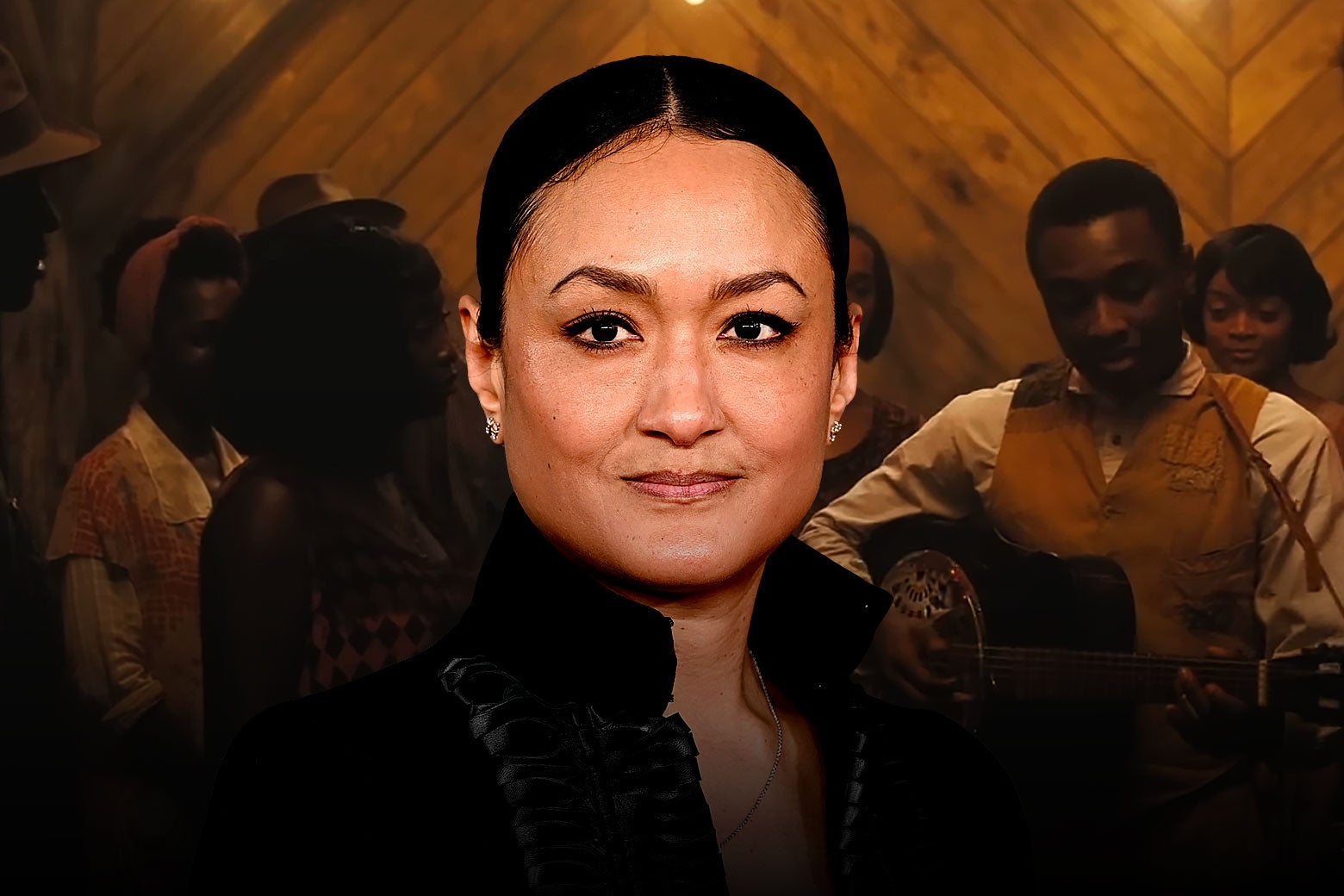
Sinners cinematographer Autumn Durald Arkapaw just made history as not only the first woman of color but the first woman, full stop, to ever win the Oscar for Best Cinematography. “I’m so honored to be here and I really want all of the women in the room to stand up because I feel like I don’t get here without you guys,” Arkapaw stated in her acceptance speech (which also included a nod to pioneering cinematographer Ellen Kuras). At this point, it’s a bit passé to remain surprised by the number of Oscar “firsts” Hollywood still manages to achieve as the years go by, but this one was particularly hard to square. How is it possible that the academy has never, in the category’s 98-year history, given the Best Cinematography award to a woman?
When the Oscar nominations were first announced, Arkapaw’s nod, and the hubbub about her potential to make history that it inspired, opened my eyes to something I hadn’t quite noticed. We all know that Hollywood has historically been a man’s world, but I hadn’t realized that, after years of pushing to diversify the industry in nearly every aspect, cinematography remains one of entertainment’s most male-dominated sectors. When it comes to the Academy Awards, every category outside of the gendered acting races has seen a woman walk home with a tiny golden man, yet all of the century’s 70-plus winning cinematographers have been men. A woman wasn’t even nominated in the field until 2018, when the academy gave Rachel Morrison (who was also mentioned in Arkapaw’s speech) recognition for her work on Dee Rees’ Mudbound.
This is, in part, the status quo for cinematography as a profession. For decades, the American Society of Cinematographers, founded in 1919, was, quite literally, a boys’ club, only inviting its first woman into the group 60 years after it was established. This is a large difference compared to the Directors Guild of America, which let a woman in for the first time in 1938. The ASC has maintained a majority-male membership since: As of 2019, only 18 of the ASC’s 390 members are women. Still, at least the ASC is making strides: Last year, Elvis cinematographer Mandy Walker was elected as the first female president in the society’s history.
But the problem has not just been the American Society of Cinematographers. The statistics are alarming across the industry, even by its own male-dominated standard. San Diego State University conducts an annual report on women in Hollywood called the Celluloid Ceiling. In 2016, the study showed that only 5 percent of the year’s 250 major Hollywood releases that year had a female cinematographer. The 2025 edition reported that women made up a mere 7 percent of cinematographers that worked on the year’s top 250 films—a meager increase. Indeed, cinematography is often the area that ranks the lowest on the Celluloid Ceiling, and 2025 was no exception. Overall: “Women fared best as producers (26%), followed by executive producers (21%), editors (20%), writers (20%), directors (10%), and cinematographers (7%).” Now Arkapaw is one of the women turning the tides, alongside Walker, Morrison, and more.
And it’s worth noting that, if any production was going to set the stage for a woman to break this barrier, it’s no surprise that it was one helmed by writer-director Ryan Coogler. Coogler has a long history of lifting up women in Hollywood, particularly in the technical areas. In fact, he’s worked with female cinematographers, including Morrison, on every single one of his films. And many of these women, like Morrison, have broken records in myriad ways. Maryse Alberti, who was the director of photography on Creed, was the first contemporary female cinematographer to have her work featured on the cover of American Cinematographer. And, of course, there’s Arkapaw, who, before Sinners, worked with Coogler on Black Panther: Wakanda Forever.
Still, what really got Arkapaw her start in working on feature films was working with female directors, particularly Gia Coppola, with whom Arkapaw has teamed up thrice, as well as Ry Russo-Young and Emma Forrest. This points at something the Celluloid Ceiling has put into numbers: The nature of this disparity is somewhat self-fulfilling, as men tend to hire other men, while the demographic who most advocates for women is women. “Films with at least one woman director employed substantially more women in other key behind-the-scenes roles than films with exclusively male directors,” the study reports. The numbers are striking: “On films with at least one woman director, women comprised 71% of writers, 28% of editors, and 22% cinematographers. In contrast, on films with male directors, women accounted for 11% of writers, 19% of editors, and 5% of cinematographers.” If women are not invited into the ASC, or not tapped to helm Hollywood’s big pictures, then they can’t let other women in to join them.
For his part, Coogler explained to Variety that his role in attempting to break this cycle is due to a simple truth: “I feel like women are better filmmakers than men.” He continued by stating that women, “in film school, life, whatever,” are “equipped to do this job, in many ways, better than” men. “We’re going to get better movies” with more female filmmakers, and “the industry would improve,” he said, but “they’ve got to be given the opportunity.”
Still, the credit goes, in the end, to Arkapaw, whose work on Sinners speaks for itself. She is, after all, the cinematographer behind perhaps the most dazzling and most discussed shot in any 2025 movie: the several-minute-long uninterrupted Steadicam shot that serves as Sinners’ showstopping centerpiece, knitting together past, present, and future as the performers blast the lid off the juke joint and the camera soars into the atmosphere. And who could forget Jack O’Connell falling into frame as our introduction to Remmick, or the hues of sunset and sunrise throughout the movie.
Thankfully, women are becoming increasingly recognized for their work behind the camera, not only in film or Hollywood but elsewhere, too. Just last year, Jessica Lee Gagné made history as the first woman to win the best cinematography Emmy for her work on Severance. And there have been more intersectional wins. In 2020, Rina Yang became the first Asian woman to join the British Society of Cinematographers. (Yang is perhaps best known for her work on The Fire Inside, the directorial debut of … Rachel Morrison.) But for now, it seems that to make some cracks in this glass ceiling, you have to literally blow the roof off.