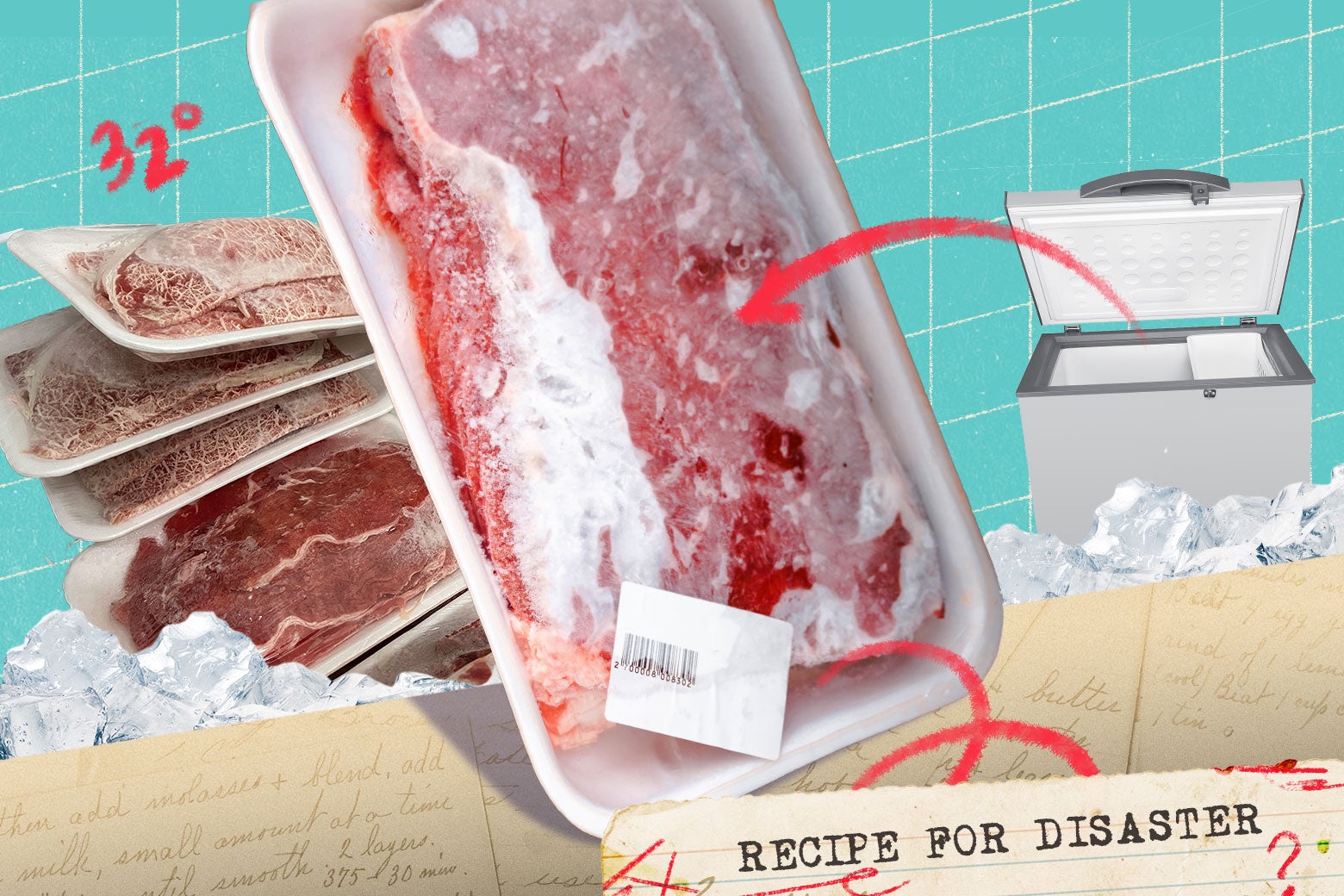
Recipe for Disaster is Slate’s column about the things recipes get wrong—and how to fix them. If you’ve noticed a recipe annoyance, absurdity, or outright lie, file your complaint here and we will investigate!
I hope that by this late point in history, we are all aware that frozen food is a good thing. Depending on what and how you freeze, studies show that food often retains its essential vitamins and minerals quite well, and flash-frozen, “peak of ripeness” vegetables, fruits, and even proteins can often be of a higher quality than what you may find on any given day at the store. Add the fact that the freezer offers a lengthy cooking grace period that the treacherous fridge can never match, and there’s just no question that home cooks should keep an arsenal of frozen food available at all times.
OK, done. But then we have a problem: It’s coming on suppertime, and our chicken thighs are hockey pucks. We’ve got to get thawing—but how? Is it too late? Will it be safe? Have we locked all our sustenance in ice, never to be fed again?!
There’s a lot of confusion (and frustration) out there about how to properly thaw food. What do you mean, my package of ground beef won’t be cookable in two hours??? But the real meat (still frozen) of this issue can be found in a lively Reddit thread titled “ ‘Thaw overnight in the fridge’ has to be one of the biggest lies of all time.” The original poster’s plight goes as follows:
I don’t know what temperature people who say this are keeping their refrigerator at, but if it’s warm enough that your meat thaws from frozen solid in it overnight, there’s no way it’s any safer than leaving it on the counter. [I] just put two chicken breasts in the fridge overnight to thaw aka doing nothing for no benefit because, 12 hours later, they’re still frozen as solid as when they went in.
“So is everyone lying?” the commenter finally asks. The answer? Pretty much.
First, let’s talk about the ways of thawing food that have been deemed officially safe. Is it OK to thaw something in hot water? What about leaving it on the counter all day while you’re at work? While these methods have no doubt functioned fine for many of us without incident, according to the Department of Agriculture, they’re a big nope.
These methods of thawing may lead to foodborne illness. Raw or cooked meat, poultry or egg products, as any perishable foods, must be kept at a safe temperature during “the big thaw.” They are safe indefinitely while frozen. However, as soon as they begin to thaw and become warmer than 40℉, bacteria that may have been present before freezing can begin to multiply.
And even though your handy microwave comes with a built-in defrost button, nuking isn’t a great method for defrosting either. A few years back, professor Costas Stathopoulos of Abertay University in Dundee revealed on a BBC show that thawing food inside a microwave quickly breeds bacteria. Meat is also more likely to lose moisture, taste dry, and even start to actually cook in some areas before the rest is thawed.
So, not on the counter, not in a microwave, and not in hot water. Got it. Well, then, greater food-science community, what are our options here? “When thawing frozen food, it’s best to plan ahead and thaw in the refrigerator where it will remain at a safe, constant temperature—at 40℉ or below,” the USDA site recommends. Heard. The problem is, that takes time.
Frustratingly, the refrigerator is far and away the longest of the thawing methods. And the “thaw overnight” directive is, indeed, a well-traveled lie. If your fridge is anywhere close to the proper temperature, it just won’t happen. The USDA suggests that even small amounts of frozen food, like a pound of ground beef or chicken breast, require a full day to thaw. Unless you’ve got horrible depression, that’s not overnight. So when a body builder on Reddit says they put two chicken breasts in the fridge and 12 hours later they’re still frozen solid, well, duh, my swole dude.
But let’s dig into this a little more. It turns out there are a few variables to take into account with refrigerator thawing. First, that temp issue: What’s yours set at? The recommended fridge temperature to prevent bacteria growth is at or below 40 degrees. Some refrigerators are set lower or run cold. Currently, my fridge at home recommends a temperature of 37 degrees. The temperature is adjustable, however, allowing for a range between 34 and 44 degrees. Also, where is the frozen material being placed? As we all know, food at the back of a fridge, near where the cool air comes in from the freezer in many models, can freeze or stay that way (especially if there are issues with airflow). RIP that whole box of spring mix salad that’s now transformed into green glass.
But even given a full 24 hours, I actually don’t buy for one second that a pound of frozen-solid meat will thaw completely. To test my skepticism, I conducted a simple experiment: I attempted to thaw a pound of grass-fed ground beef toward the front of a refrigerator at 37 degrees. After 12 hours, it was still frozen like a brick. Twenty-four hours later (when the special meat alarm on my phone went off), I would describe the ground beef as “loosened” but still not thawed. It took almost 30 hours for the pound of beef to fully thaw. Thirty hours!
There’s got to be a quicker, more effective way to do this, you might be thinking. One that doesn’t require the foresight of knowing what I want to eat four meals from now, when I couldn’t decide what to eat for dinner right now if you put a loaded gun to my head. Well, reader, there is. It’s a method I’ve been using both in restaurants and at home my entire adult life, and you already have all the fancy gear you need to pull it off: running water.
Overwhelmingly, professional kitchens use cold running water to thaw food. This method involves fully submerging food in cold water while a running faucet replenishes said water over it (and, ultimately, down the drain). Why do chefs prefer cold water to the fridge? Because it’s faster, yes, and also because this method is thought to provide better texture than the lengthy refrigerator thaw.
For what it’s worth, the USDA supports a less effective version of this approach, so long as the food is in a leakproof package. If the water is changed every 30 minutes, “small packages of meat, poultry or seafood—about a pound—may thaw in an hour or less,” it says. “A 3- to 4-pound package may take 2 to 3 hours. For whole turkeys, estimate about 30 minutes per pound.” That’s because water is denser than air, making it a faster conductor of heat. But running water is an even faster conductor of heat. This is why it’s industry standard to keep water running over frozen products while they’re in the sink, as opposed to just sitting in the government’s shallow pool. Of course, I never got this science lesson working in red-sauce joints. Some Italian man with a shiny chin just screamed at me to make sure the faucet kept running over a box of calamari.
But you don’t have to take it from me. “The reason that running water is so effective is because the water moving defrosts much faster than stagnant water,” said Bob Broskey, executive chef partner at RPM Restaurants. Broskey oversees the chef teams at RPM Restaurants nationwide, so the man knows what’s going on in kitchens. To my knowledge, thawing out food by using running water is the way restaurants have done things for decades. Broskey confirms this: “That is still the industry standard, for sure, but it wastes an incredible amount of water.”
And that’s the biggest problem with thawing: The best solution is also the most wasteful. Broskey, however, excitedly sent me a link to a machine that he uses at all of the restaurants he heads, and it doesn’t waste any water. It’s called the CNSRV WTR defroster (they’ve got to come up with a catchier name). “Think of it as a circulator for water that keeps it cold,” Broskey said. So, instead of rushing new cold water out of a spigot and down the drain, the CNSRV defroster circulates the cold water in the sink, keeping a food-safe temperature, and even providing faster thaw times. According to CNSRV co-founder and President Dylan Wolff, the more rapidly you can defrost food, the better its flavor profile remains. The CNSRV website states that the faster food thaws, the better the texture and taste will be, citing “mushy texture” as a con to refrigerator thawing. (It should be said that I personally have never noticed an actual textural difference between shorter water thaws and long refrigerator thaws.)
The CNSRV website also claims that kitchens waste 1 million gallons of water annually with the old running-water method of defrosting, and I do believe that. Every kitchen I’ve ever worked in used this technique, and every time I couldn’t help but think that we were running money and resources down the drain. When I set out to write this piece about the overnight thaw, I didn’t expect to become so optimistic about a solution to water waste. Seeing the circulator in action is awesome and gives me (a smidge of) hope for the future.
But is this a practical instrument for thawing at home? Well, do you happen to have a triple sink in your one-bedroom apartment? And where would one fit a big ol’ clunky commercial kitchen defroster anyway? Next to the waffle iron? The answer is, of course, no. (In theory, if you have a sous vide stick at home, it can also be used to thaw food quickly, though it’s not what the device is built for. Ice would be needed, and the temperature would have to be set to 40 degrees or cooler, or to a “circulate only” mode, which not all models offer. I don’t own an immersion circulator, but if you do it seems to be worth trying.)
So where does this leave home cooks? Well, with a decision to make. If we’re going to be sticklers for safety, we ought to eliminate microwave thawing, counter thawing, and hot-water thawing. Which leaves two choices: running water or the fridge (with a lot of planning). And a larger question: How comfortable are you with wasting water? In a pinch, if you forgot to thaw something out for dinner, I’d say you can use the running-water method. However, I would also implore you, especially if you live in a place like California, to try to align yourself with the slow pace of the refrigerator. The food’s quality likely won’t deteriorate. Just be thoughtful and patient, because this is the best method we have. But don’t expect to have your steaks ready to go after a few REM cycles. Because Rome wasn’t built in a day, a watched pot never boils, slow and steady wins the race, and good food doesn’t thaw overnight.